
Which handpan is suitable for beginners?
An honest guide for beginners
Anyone encountering the handpan for the first time is quickly faced with a seemingly simple question – which, upon closer inspection, proves to be surprisingly complex:
Which handpan is suitable for beginners?
The selection is vast, the price differences enormous, and the terminology often unclear. At the same time, you constantly hear that the handpan is "intuitive," "easy," or "suitable for everyone." That's true— but not every handpan is equally suitable for beginners .
This article will help you make an informed decision. No myths, no overwhelm – just a musical and technical perspective.
In short: Yes – however, “beginner handpan” does not mean an inferior instrument, but rather a well-thought-out selection.
A good beginner handpan is clearly structured, accurately tuned, and provides guidance while playing. The crucial factor is not the name, but rather:
- the mood
- the tonal range
- the sound stability
- and the processing
While poorly built instruments quickly reach their limits, a high-quality handpan remains musically viable even in the long term.
This question comes up frequently – for example, in connection with extremely cheap offers in the lower three-figure range.
Comparing this to other instruments is helpful here:
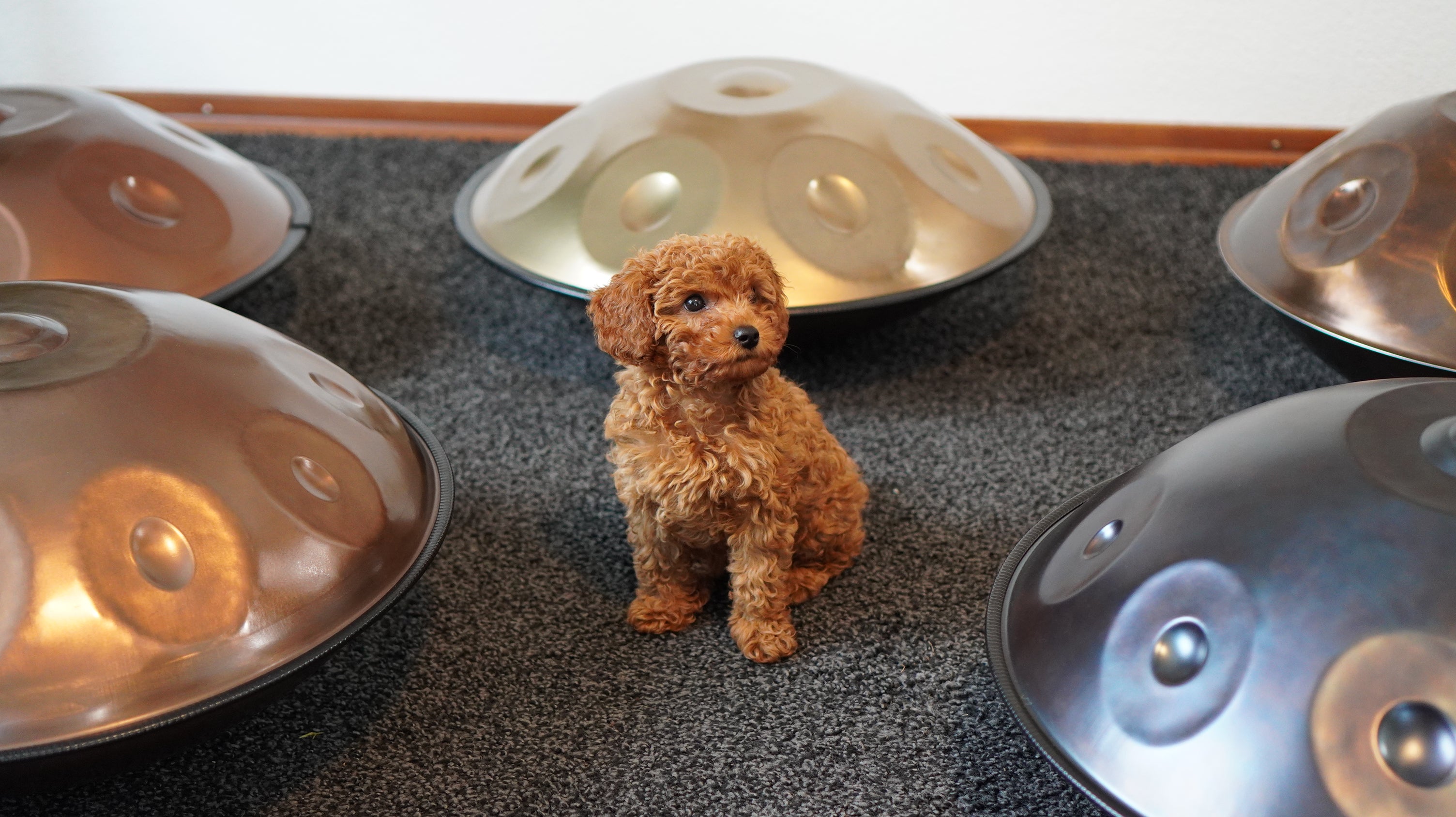
A very cheap guitar from the supermarket is playable – but often poorly set up , with a limited sound , and not very motivating . High action , an overly wide fretboard , imprecise workmanship , and a flat tone make playing difficult. Many people therefore quickly give up – not out of lack of interest , but out of frustration .
The same applies to very inexpensive handpans. They are often:
- inaccurately or unstably tuned
- The sound lacks differentiation.
- harder to hit
- uneven in volume and resonance
The result is not a realistic impression of the instrument . The sound is harsh or tinny , subtle nuances are missing – and precisely what makes the handpan special remains hidden .
Paradoxically, such instruments are not easier , but often more difficult to play than well-made handpans. Instead of motivation, uncertainty arises, and the enjoyment of playing is quickly lost.
A beginner's handpan should therefore not be as cheap as possible, but rather playable, tonally balanced, and reliable . Only then can the true quality of the instrument be experienced – even with simple patterns and slow tempos.
Which mood is suitable for beginners?
The tuning – that is, the scale of a handpan – is the most important factor when choosing the instrument. It determines not only the sound, but also how easily musical relationships can be understood.
Each handpan is tuned to a specific scale. This determines:
- which tones are available
- how melodies and patterns can be formed
- how well one can orient oneself while playing
Especially for beginners, a mood that is clearly structured and offers a clear musical framework is helpful.
A musical scale basically consists of seven different notes .
These seven notes form the complete musical framework on which a great deal of music is based.
There are different approaches to handling this scale on handpans:
- Some moods use all seven tones.
- Others deliberately reduce the selection to six or five tones.
The more completely the musical scale is represented, the more musical relationships can be recognized, repeated and further developed – which opens up more possibilities in the long run.
What does this mean for beginners?
Tunings that contain all seven notes of the scale offer:
- more orientation while playing
- a better sense of melodies
- More development opportunities in the long term
Reduced moods with fewer notes can be very atmospheric and sound beautiful quickly. At the same time, the musical framework is narrower, since not all notes are available.
This is where a misunderstanding often arises:
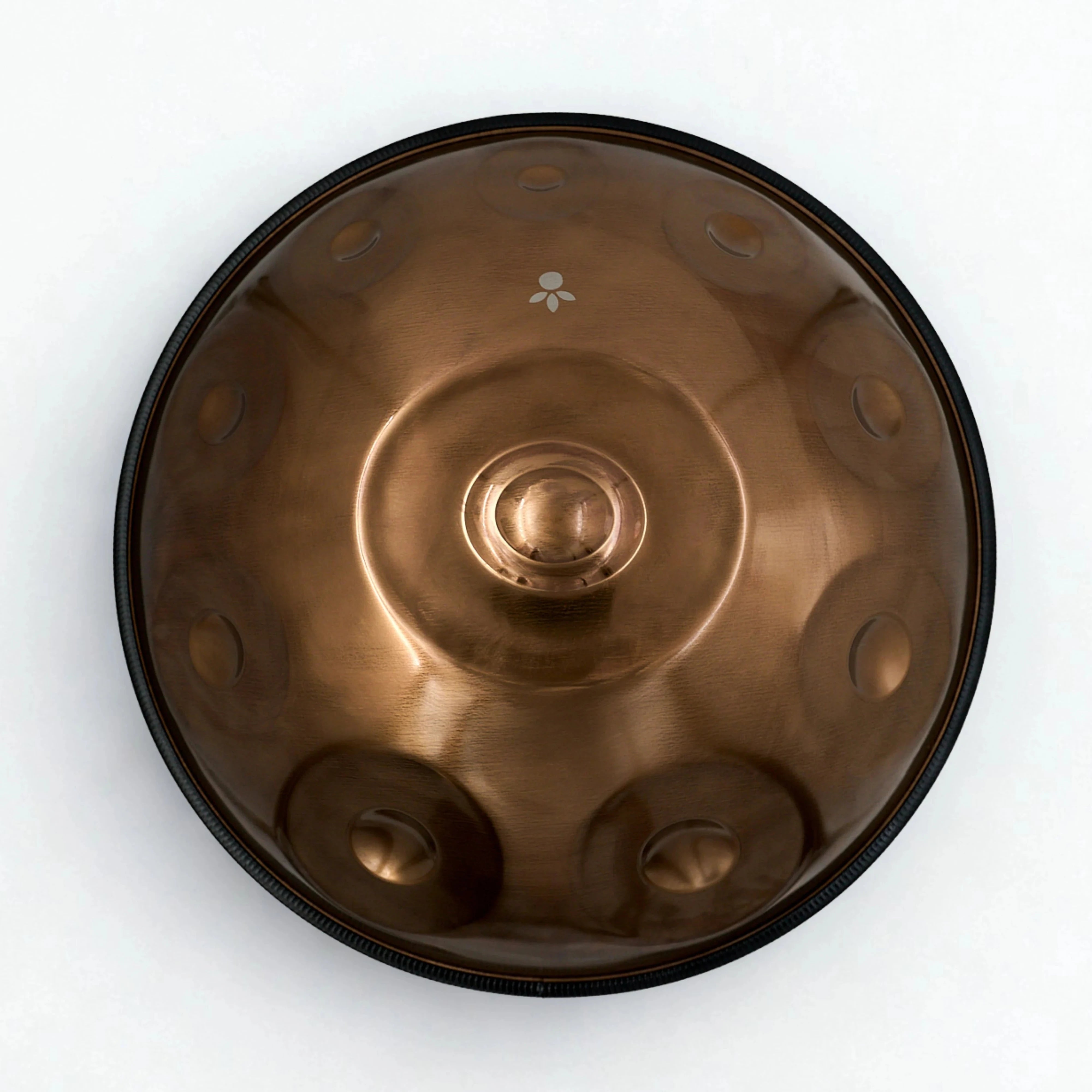
Many handpans – including classic beginner models – have more than seven tone fields , often ten , for example.
However, this does not contradict the musical scale .
The reason:
The seven different notes of the scale are used multiple times on the handpan in different positions . Certain notes therefore appear a second time – sounding higher or lower .
This results in:
- more room for melodies
- smoother transitions
- greater expressive possibilities
A handpan with ten tone fields does not therefore mean that it contains ten different tones.
Rather, individual notes of the scale are used multiple times to expand the musical range .
Handpans with only seven tone fields do exist, but they are rather the exception and not automatically better or easier for beginners.

The Scale Finder
Anyone wishing to delve deeper into the different handpan tunings will quickly encounter many terms: Kurd , Amara , Celtic , Pygmy , Aegean and others.
To provide guidance here, we have developed a Scale Finder – a free guide that clearly explains the most common handpan tunings, classifies differences and shows how the tonal range , character and playing feel differ from each other.
The Scale Finder is explicitly aimed at beginners and helps to classify terms and find one 's own sonic direction – without prior knowledge .
Why D Kurd is so frequently recommended
D Kurd is one of the most widely used handpan tunings , especially for beginners .
The reason is simple:
D Kurd typically uses all seven notes of the underlying D minor scale, thus representing a complete musical system . This facilitates learning , pattern recognition , and the further development of playing .
Furthermore, this tuning was incorporated early in the development of the handpan . As a result, D Kurd has established itself as a common foundation over time.
Classification
D Kurdishness is not mandatory and does not imply a "better" mood than others.
However, it offers a very reliable basis for learning to play the handpan from scratch and for developing skills in the long term .
An important practical aspect is also involved:
A very large portion of the available content – YouTube videos , online courses , tutorials , and practice examples – is based on Kurdish or at least designed to be. This makes getting started significantly easier .
While it is often pointed out that the content shown can be "transferred to any scale," in practice it often remains unclear how this transfer actually works . This is particularly challenging at the beginning: one has to rethink musical sequences , adapt patterns , and translate musical relationships to one's own mood .
For beginners, this often means unnecessary complexity – not because their own scale is unsuitable, but because in addition to playing technique, translation is also required.
With a widespread mood like D Kurd, much of the learning content can be applied directly and without detours . This reduces pressure , facilitates practice , and leads to faster success .
For precisely this reason, D Kurd is considered a sensible starting point by many:
not because it restricts, but because it provides guidance .
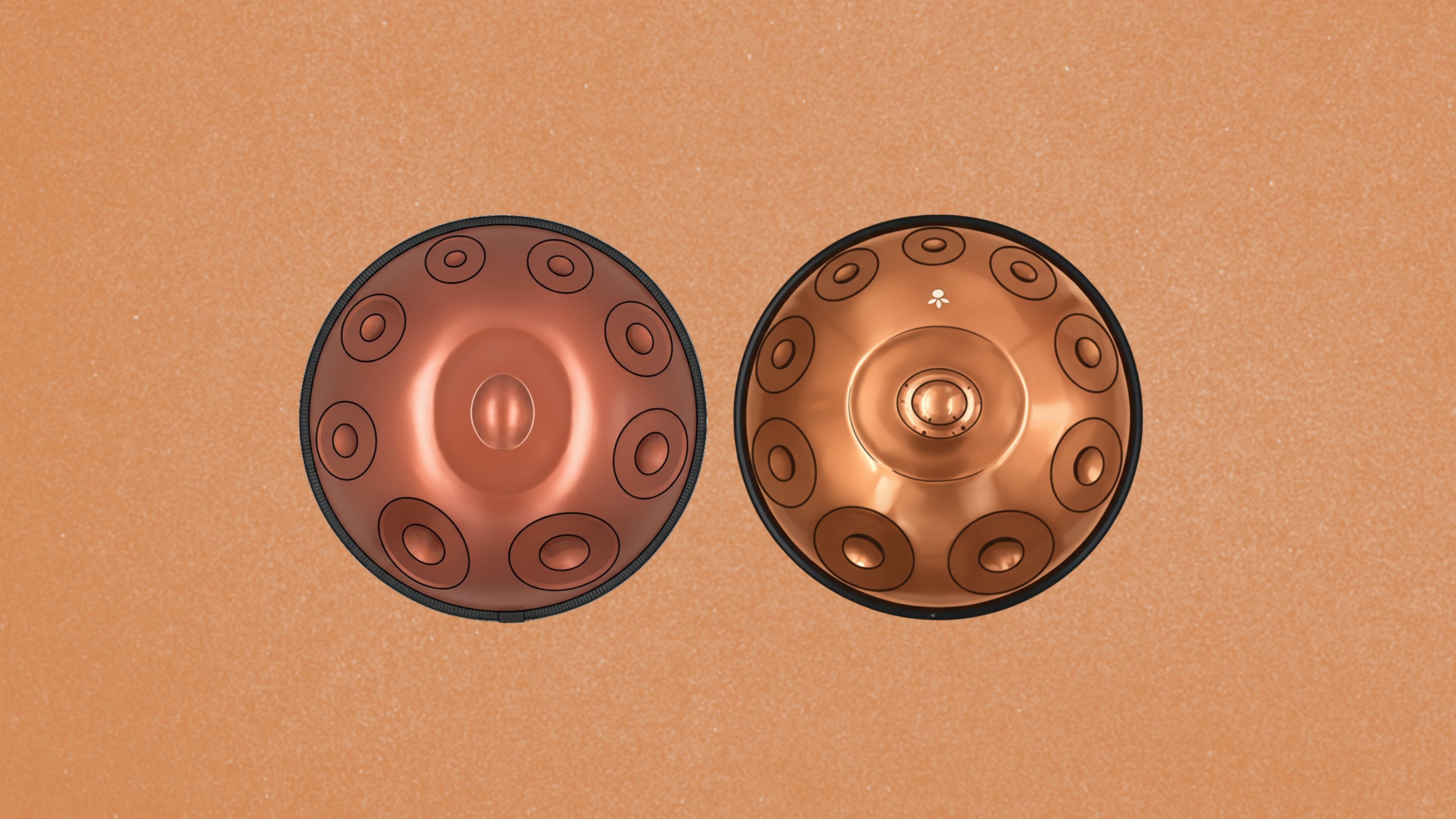
What do D Kurd 8+1, 9+1, 9 or 10 mean?
When you see names like D Kurd 8+1 , 9+1 , 9 or 10 for handpans, this mainly describes how many tone fields the instrument has – and whether a middle tone is included.
The "+1" almost always represents the object in the middle. So, 8+1 means: 8 outer tone fields + 1 object = 9 tones in total . With 9+1 , it's 9 outer tone fields + 1 object = 10 tones in total . Some people simply write "10" instead of "9+1".
Important for beginners: A D Kurd 10 is not "completely different" from a D Kurd 9 – it simply has an additional note at the very top of the scale, which expands its playing range. This means you can play everything on a 10 just like you would on a 9 – only with more options , for example, for melodies, transitions, or variations.
Therefore, we primarily carry the D Kurd 10 in this area – it is the most sensible standard for most people because it covers everything you can play on a 9-string keyboard and also offers more flexibility.
How many clay fields are useful for beginners?
More tonal fields generally mean more musical possibilities . However, especially at the beginning, this variety can also seem overwhelming while orientation, listening habits, and playing feel are still being developed.
Therefore, what matters is not the maximum number of sound fields, but how clearly the sound space is structured and how well relationships can be understood.
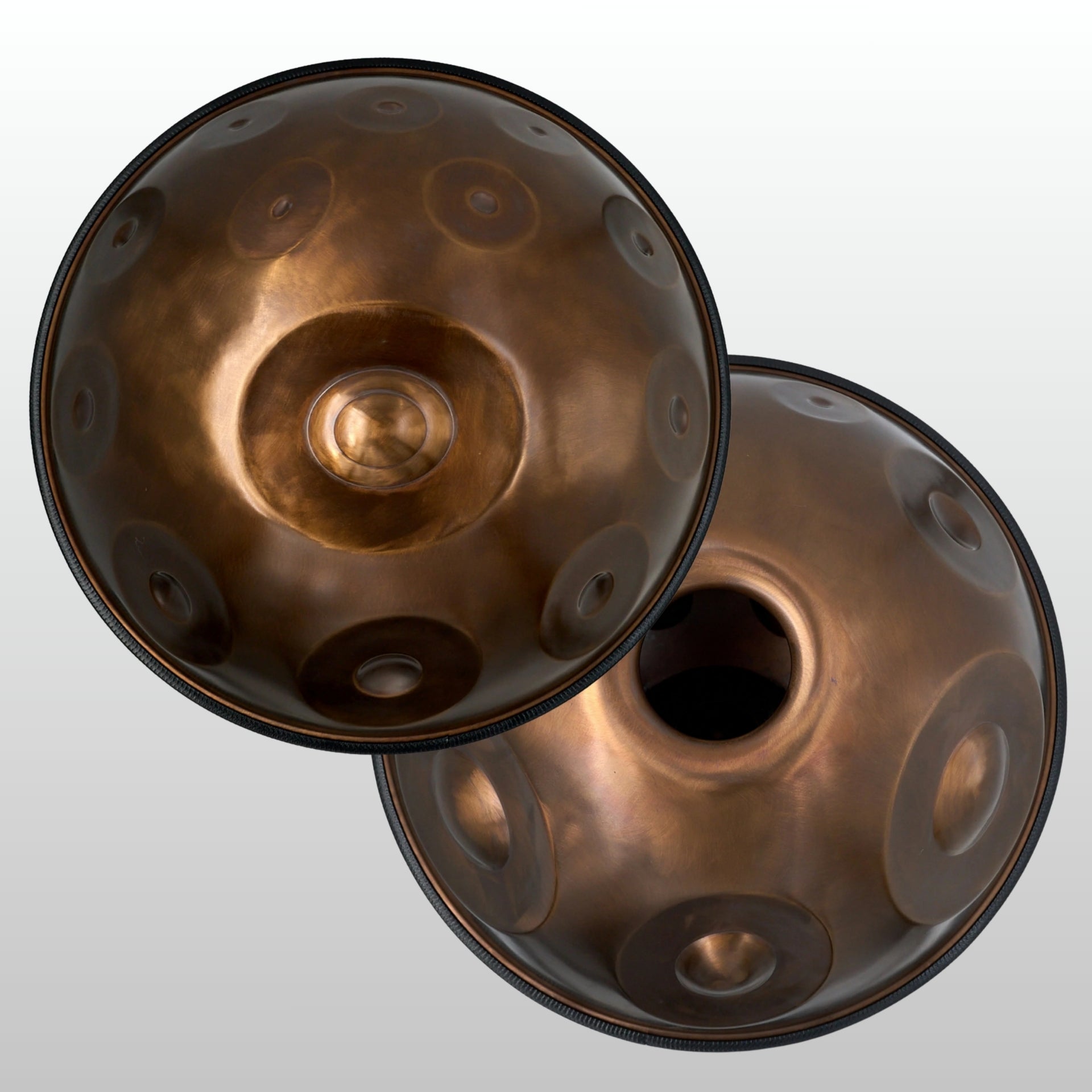
For many beginners, an instrument with 8 to 10 tone fields on the top has proven effective. Not because it's less capable – but because it sharpens the focus.
A clearly structured tonal space:
- supports conscious listening
- facilitates the repetition and variation of patterns.
- helps to internalize musical concepts more quickly.
Instead of constantly switching between many options, space is created to develop depth in the game.
Those who start thinking about an expanded instrument early on can also choose a different path.
Extended handpans offer additional tone fields – often on the underside – thus opening up new sonic dimensions , for example for bass lines, accompaniment or polyphonic playing.
Models that retain the same layout as a standard instrument ( D Kurd 10 ) have proven particularly effective here, for example a D Kurd with an extended tonal range.
Those considering this approach will find such extensions in instruments like the HPL D Kurd 14 or the HPL D Kurd 19 – both build on the familiar layout and expand it with additional tone fields.
The advantage:
All basic gameplay approaches, exercises, and learning content can still be applied directly. At the same time, additional sounds are available that can be explored gradually without having to use them from the beginning.
This ensures that learning content remains transferable, while allowing the sonic horizon to be expanded in the long term.
Of course, the financial aspect also plays a role. Extended handpans are more complex to manufacture and therefore more expensive. Whether this path makes sense depends on your own goals, budget, and intended use.
Pre-purchase orientation
A handpan is very sensitive to touch. For beginners, the playing feel is especially important.
A beginner-friendly handpan is characterized by:
- clear articulation of the tonal fields
- consistent volume
- clean reverberation without disturbing overtones
- stable mood even with regular play
If tones are difficult to respond to or react unevenly, it is rarely due to the person playing – but usually to the instrument.
One of the most common uncertainties when starting out concerns the price . The range extends from very inexpensive offers to high-quality instruments in the upper segment – and this can be quite confusing.
A well-built handpan is a handcrafted instrument . Extremely cheap offers often cut corners in crucial areas, such as:
- the material quality
- the accuracy of the voice
- long-term stability
This directly affects the playing feel and sound. Therefore, beginners should budget realistically – not for luxury, but for an instrument that motivates rather than frustrates .
The important thing is not to buy as cheaply as possible, but to buy sensibly .
It was precisely with this idea in mind that we developed an entry-level model - our HPL Starter D Kurd 10 - which is deliberately focused on the essentials:
A cleanly tuned instrument with ten tone fields , in the widely used Kurdish tuning , clearly structured and usable in the long term.
The goal was not to offer the cheapest handpan, but one that:
- delivers an honestly good and beautiful sound
- It is very playable
- and gives a realistic impression of what makes the handpan special as an instrument
Especially when starting out, the following often applies:
If you buy too cheaply, you buy twice.
At the same time, we know that buying an instrument is a personal decision. That's why we offer the option of borrowing a handpan first , so you can get to know it at your leisure – without any pressure to buy.
For those who have already made their decision but want to remain financially flexible, there is also the option of installment payments , for example via Klarna. This makes quality accessible without compromising on the instrument itself.
Conclusion – which handpan is suitable for beginners?
A good beginner handpan is:
- clearly tuned
- clearly structured
- balanced sound
- expertly crafted
It doesn't overwhelm , but invites.
It does not limit , but provides guidance.
Taking the time to choose the right instrument lays the foundation for a long-term musical relationship – regardless of whether the journey begins calmly or leads further later on.
Further reading