What is a handpan? – Sound, origin and special features explained
There are instruments you hear – and there are instruments that touch you .
The handpan belongs to the second category.
Many people experience them for the first time by chance: at a market, in a park, in a video.
A calm, floating sound fills the room, seemingly played without effort.
Warm, round, open.
Before you even know what you're hearing, you stop .
But what exactly is this instrument?
What makes the handpan so special – and why does it attract people without prior musical experience just as much as experienced musicians ?
This article provides a clear, factual and understandable answer to the question:
What is a handpan?
What is a handpan?
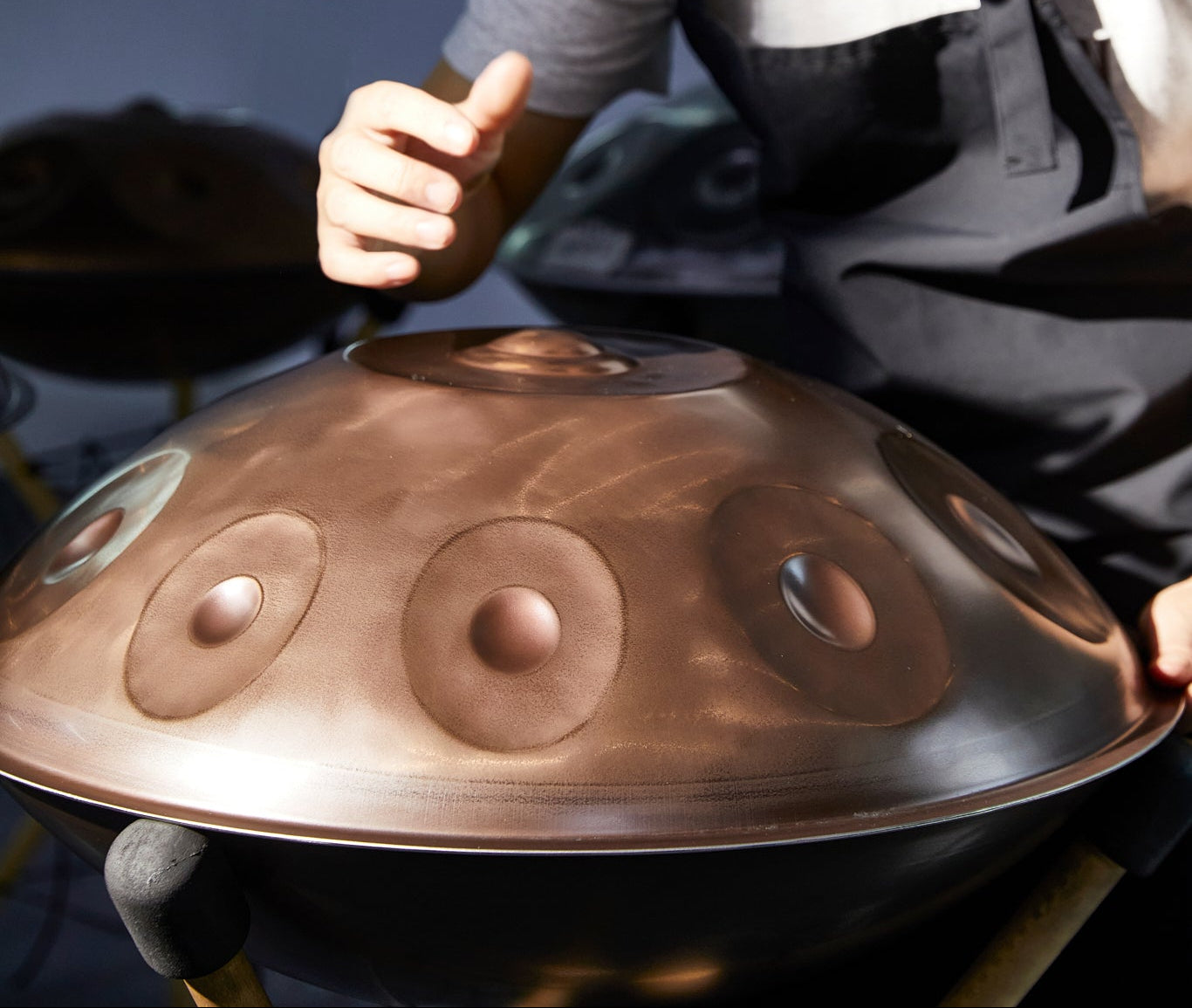
A handpan is a steel sound instrument played with the hands .
It belongs to the family of idiophone instruments – that means:
The sound is created by the vibration of the material itself , not by strings or air columns.
- made of formed steel
- It is played exclusively with the hands (there are exceptions).
- possesses a fixed mood
- combines rhythm, melody and harmony in one instrument
Unlike many classical instruments, the tones of a handpan are deliberately tuned to each other . All tone fields belong to a fixed scale and form a clearly defined sound space .
In short:
The handpan is an instrument that reduces tones – and amplifies the effect .
The sound of a handpan is fascinating due to its softness and depth .
When you strike a handpan, you don't just hear a single note , but also resonating overtones . Furthermore, handpans have a long sustain – the notes ring out for a relatively long time and weave together to form a shimmering tapestry of sound .
Many players describe the playing experience as meditative : You play with your hands (hence the name Handpan = hand pan in German) and can create gentle, singing sounds or percussive rhythms through different striking techniques.
Unlike many instruments, the handpan is very intuitive – with just a few notes you can improvise atmospheric melodies , as the notes of a scale usually fit together well .
This interplay of overtones , long reverberation and direct hand balance creates the magic of the handpan sound .
How is a handpan constructed?
A handpan consists of two shaped steel shells that are firmly glued together .
Upper shell:
This is where the tone fields are located – that is, the playable sound areas.
Bottom shell:
It serves to create sound resonance and influences volume, depth, and reverberation .
It usually has a circular opening in the middle (often called the Gu ), which serves as a sound hole . Both bowls are precisely tuned to each other .
Even small differences in material, shape, placement of fields, or tension of the steel significantly change the sound .
Besides classic models with tone fields exclusively on the top shell, there are now also so-called Extended Handpans .
These have additional tone fields on the underside or an extended tonal range . This opens up more melodic possibilities – but at the same time increases the complexity of their manufacture and the demands on the player .
In the middle of the upper shell lies the so-called thing .
It is the fundamental tone of the handpan and forms its sonic center . Further tone fields are arranged around it.
This thing provides orientation, support and depth – comparable to a fundamental tone in music.
Several clay fields are arranged around the object.
Each tone field is precisely tuned and produces a specific tone when struck (in addition, specific overtones, but that is a topic for another article).
Depending on the model, a handpan usually has 8 to 10 tone fields on the top.
Some instruments also have additional notes on the underside or even on both sides .
A handpan cannot be retuned like a guitar .
Each instrument is tuned to a specific scale – for example, a minor or major scale. This fixed tuning establishes a clear musical framework .
All tonal fields belong to a closed system ; there are no random extraneous sounds outside this sound space. This makes it considerably easier to learn without simplifying the instrument .
Handpans also contain semitones, tensions, and tonal contrasts . How harmonious or tense the playing sounds still depends on rhythm, attack, dynamics, and note combinations .
Reading sheet music is not necessary – what matters is listening, timing and feel for the game .
How is a handpan made? A look at true craftsmanship.
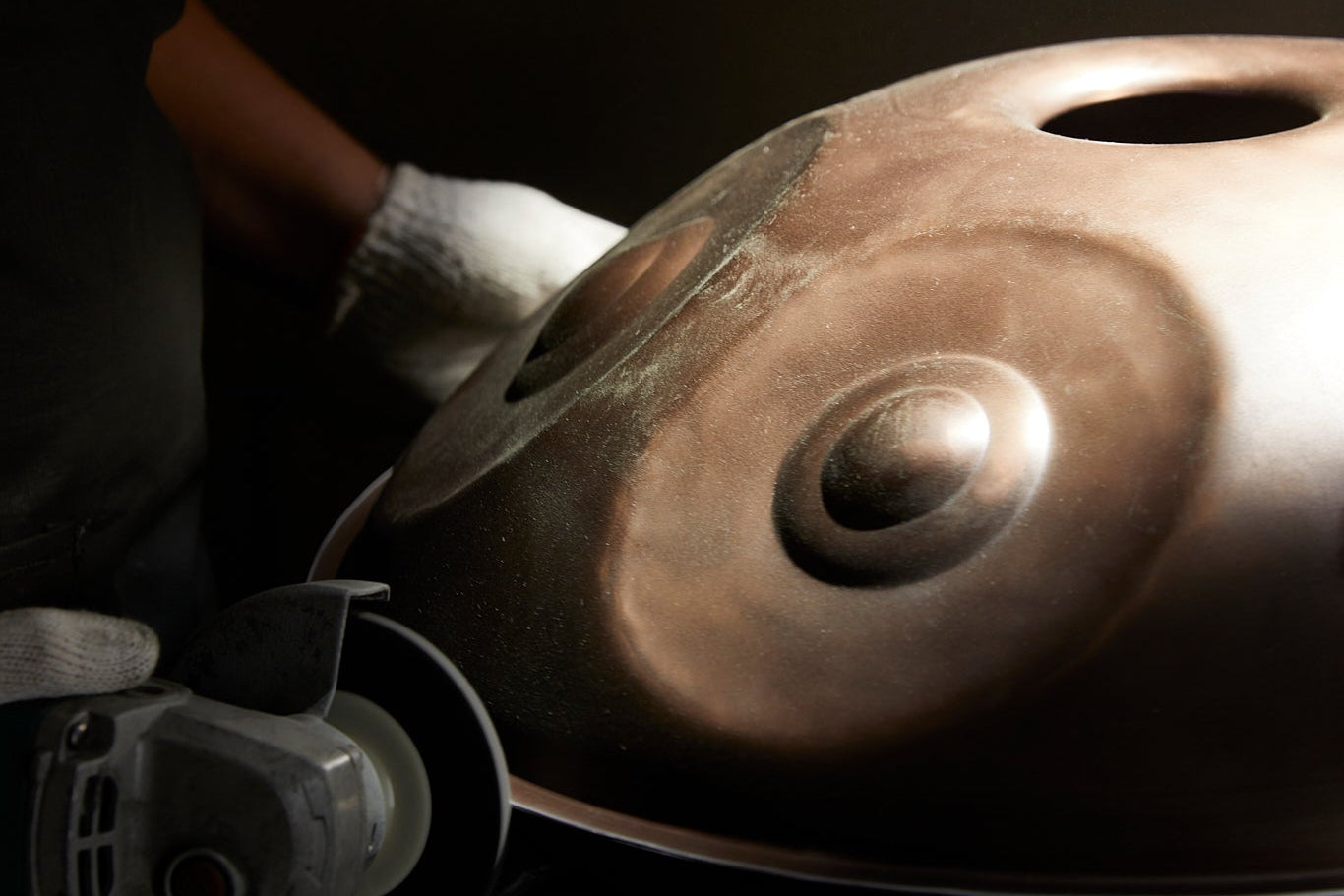
At first glance, a handpan appears almost like a "finished sound object"—round, calm, perfectly shaped. But behind this instrument lies not an assembly-line process, but above all craftsmanship, ear, and experience . Even if modern workshops now work with more precise methods, the crucial element remains human. Because a handpan isn't just "tuned correctly"—it must sound harmonious within itself .
It starts with two round steel discs: the upper shell and the lower shell . Initially, they are usually silvery and "neutral".
To become a handpan, the wood must be shaped – that is, brought into a stable, resonant curve. Depending on the workshop, this is done by pressing, hammering, or a combination of both. Much is decided at this stage: shape, tension, and material properties later influence how easily the notes respond and how balanced the instrument's vibration is.
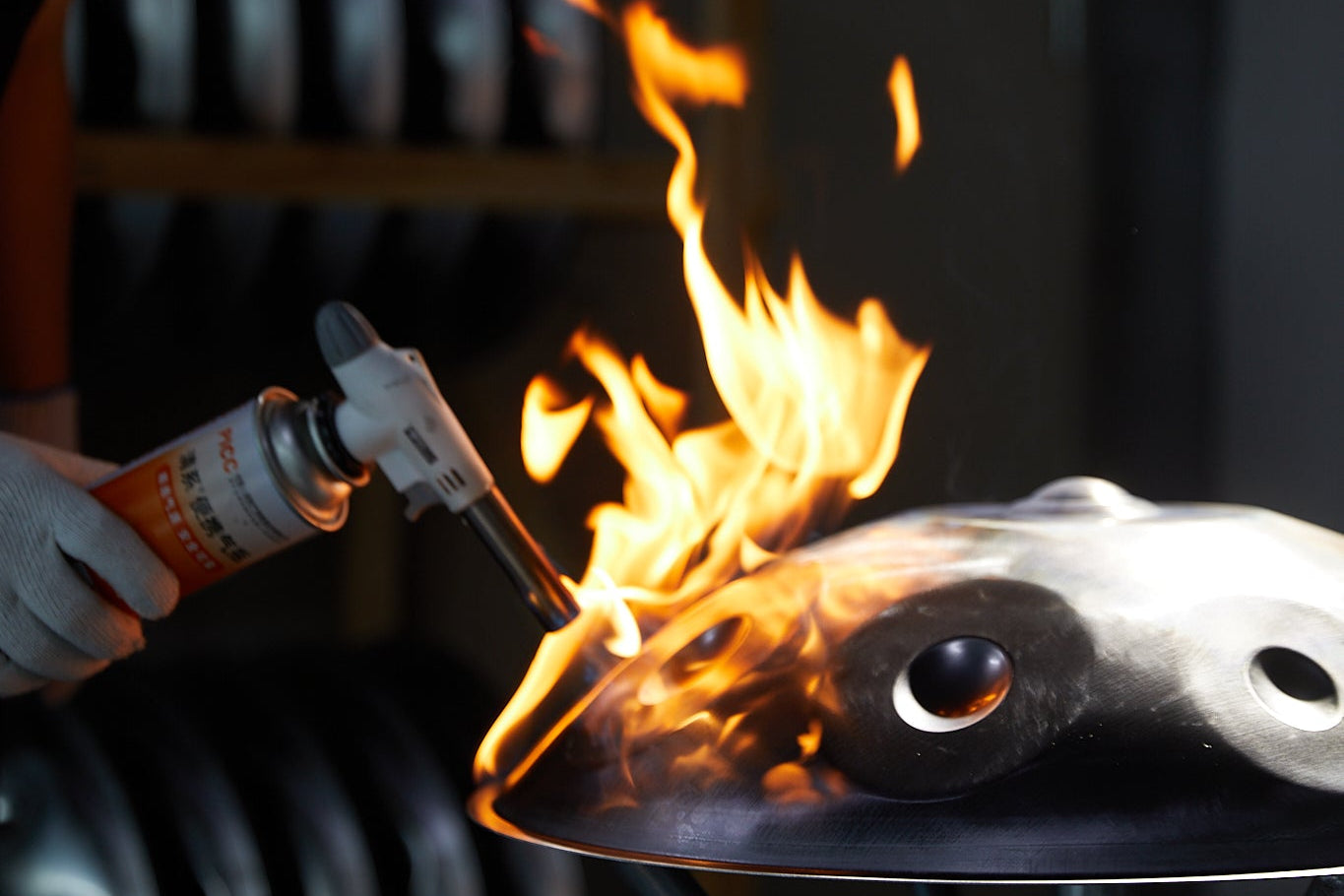
Heat and heat treatment play an important role in the manufacturing process. They influence how the steel behaves – and often also how the surface appears later (for example, through patina or so-called temper colors).
These steps take place in controlled processes , depending on the workshop, often in special ovens or heat chambers where temperature and duration are specifically controlled.
This is one of the reasons why handpans can sound very different despite similar construction: Not only the tuning counts, but also how the material was "set" through heat, tension and processing – and how stable it subsequently vibrates.
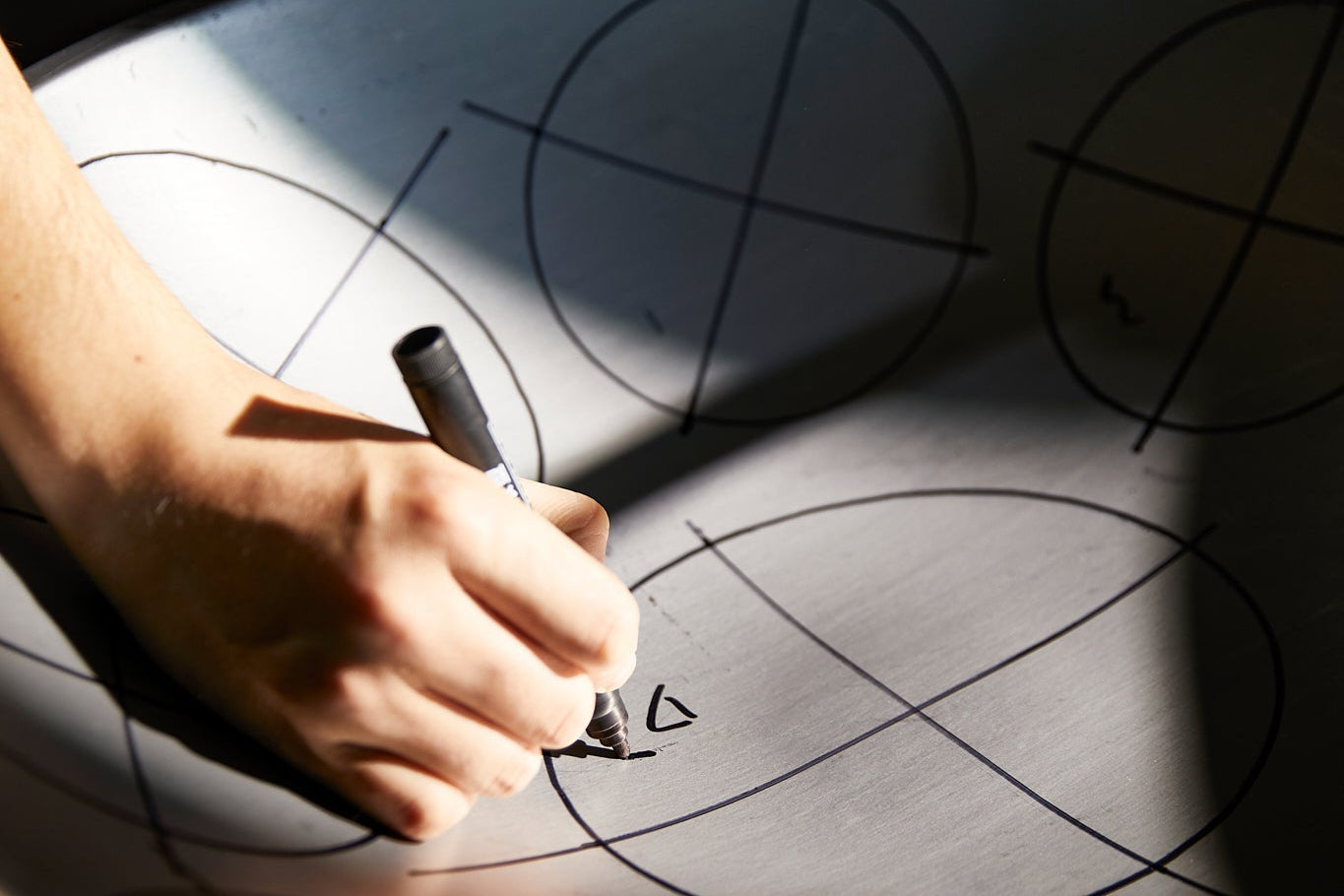
Now, the placement of each note on the top shell is determined. The fundamental tone (the "Ding") is usually placed in the center, and the tone fields are positioned around it. This isn't just about "space," but about balance : tone fields influence each other. A handpan is a system—not a set of individual notes.
What this arrangement specifically changes:
-
Size of the tone fields: Larger fields can often feel more "open" and develop greater carrying power, while smaller ones can react more directly. The field size also influences how easily a note responds and how much dynamic range is possible.
- Spacing between tone fields: If fields are very close together, they can excite each other more strongly – this can lead to beautiful resonance, but also to more crosstalk if it is not properly balanced. Greater spacing can help to separate tones more clearly.
- Distance to the rim: How close a clay field is to the rim affects the stability and resonance of the bowl. Too close to the rim can make the clay more fragile; further inwards can offer more control and balance – depending on the construction.
-
Orientation and rotation of the tone fields: Tone fields are not simply "round islands". Their shape, orientation (and also the angle at which they are positioned relative to the object and to neighboring fields) influences how the instrument vibrates – and how well certain tones harmonize with each other.
- Playability and layout: The placement also determines how intuitive the handpan is to play: Which paths the hands find, how smoothly transitions work, whether patterns fit "logically" – or whether you constantly have to reorganize.
In short: Two handpans can have the same scale – and yet sound completely different because geometry, spacing, and orientation alter the entire vibration system. This is precisely where a large part of the craftsmanship lies: not just "tuning" notes, but building an instrument that responds harmoniously as a whole.
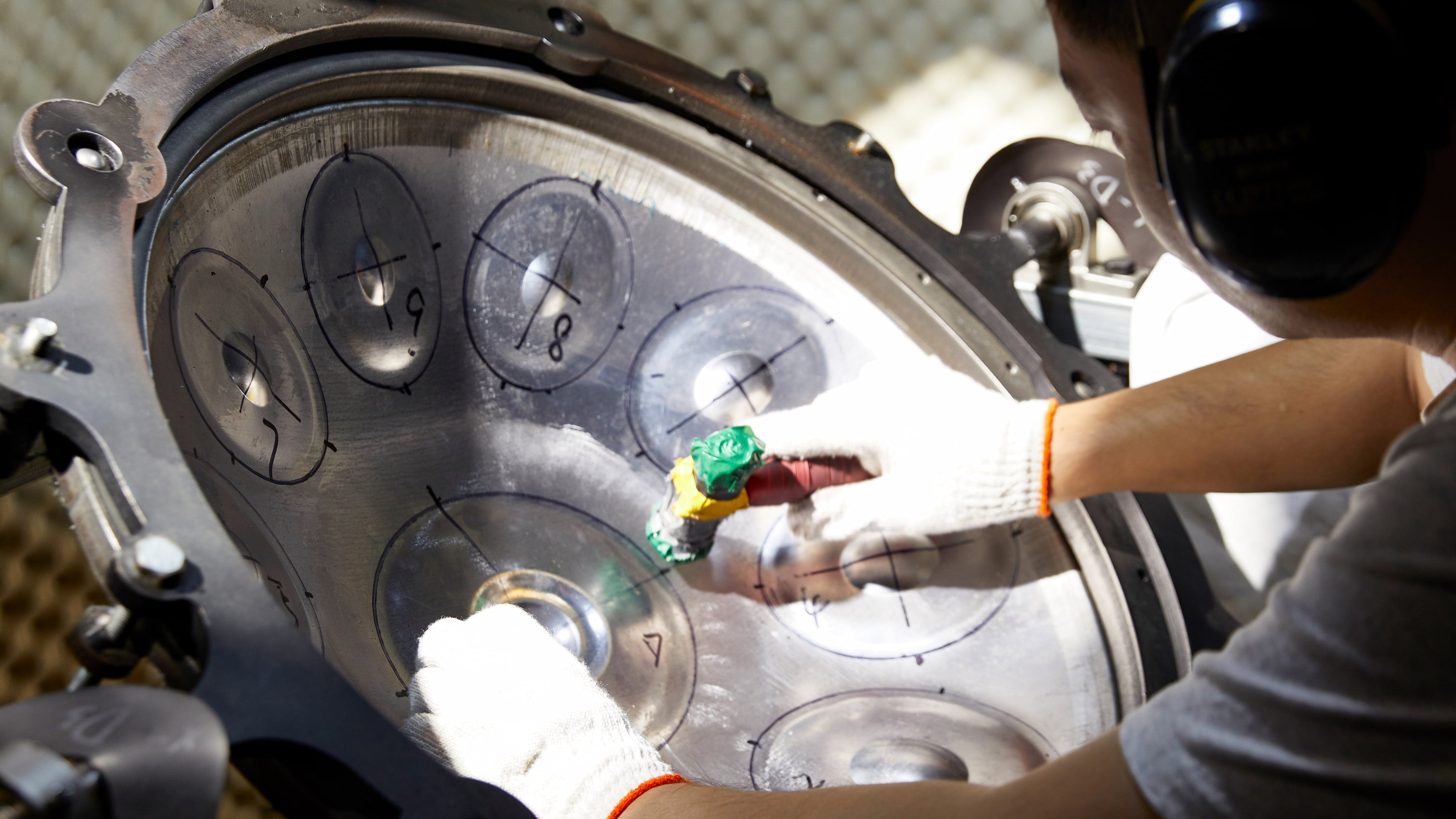
Now begins the part that is often underestimated: the tuning .
A tone field doesn't just have "one" pitch – it possesses multiple vibrational components that must function together cleanly. Good workshops tune so that a tone not only "fits" on the device, but also carries musically : clear, stable, with a pleasant resonance and without any disturbing shimmering.
And here lies a key point:
Handpans aren't about sterile perfection, but about control and musical effect . A handpan can look "perfect" on a tuner—and still sound flat, short, or unbalanced. Conversely, an instrument can be beautiful, resonant, and balanced in practice, even though a tuner shows minimal deviations. The crucial question is: How does it really sound—and how do the notes blend together?
Handpans also contain semitones, tensions, and tonal contrasts . How harmonious or tense the playing sounds still depends on rhythm, attack, dynamics, and note combinations .
The ability to read music is not necessary – what matters is listening, timing and feel for the game .
The top and bottom shells of most handpans are glued together along the seam , creating a closed resonating chamber. This may sound unspectacular, but it's a crucial step in terms of sound: joining the two shells changes the tension, stiffness, and air volume inside. This can significantly alter the volume, projection, and overall "feel of size."
It's important to know that after gluing, an instrument often needs fine-tuning . This isn't because it's "poorly made," but because the system rebalances itself after being closed. This is especially true for extended handpans (with tone fields on the bottom as well), because even more parts are interconnected. Many workshops therefore tune in stages: before gluing , after gluing , and after a short settling period – until everything sounds stable and balanced.
Finally comes what you often feel most later: fine-tuning and quality control .
Good workshops check:
- whether the tones respond evenly
- whether the volume levels match each other
- whether the instrument remains stable (even during dynamic playing)
- whether there are no disturbing background noises, "wobble" or unwanted resonances dominating.
Only when these details are right does this feeling arise that you can't measure – but immediately notice: The instrument is "perfect".
Handpan Material & Finish: Where do the colors come from?
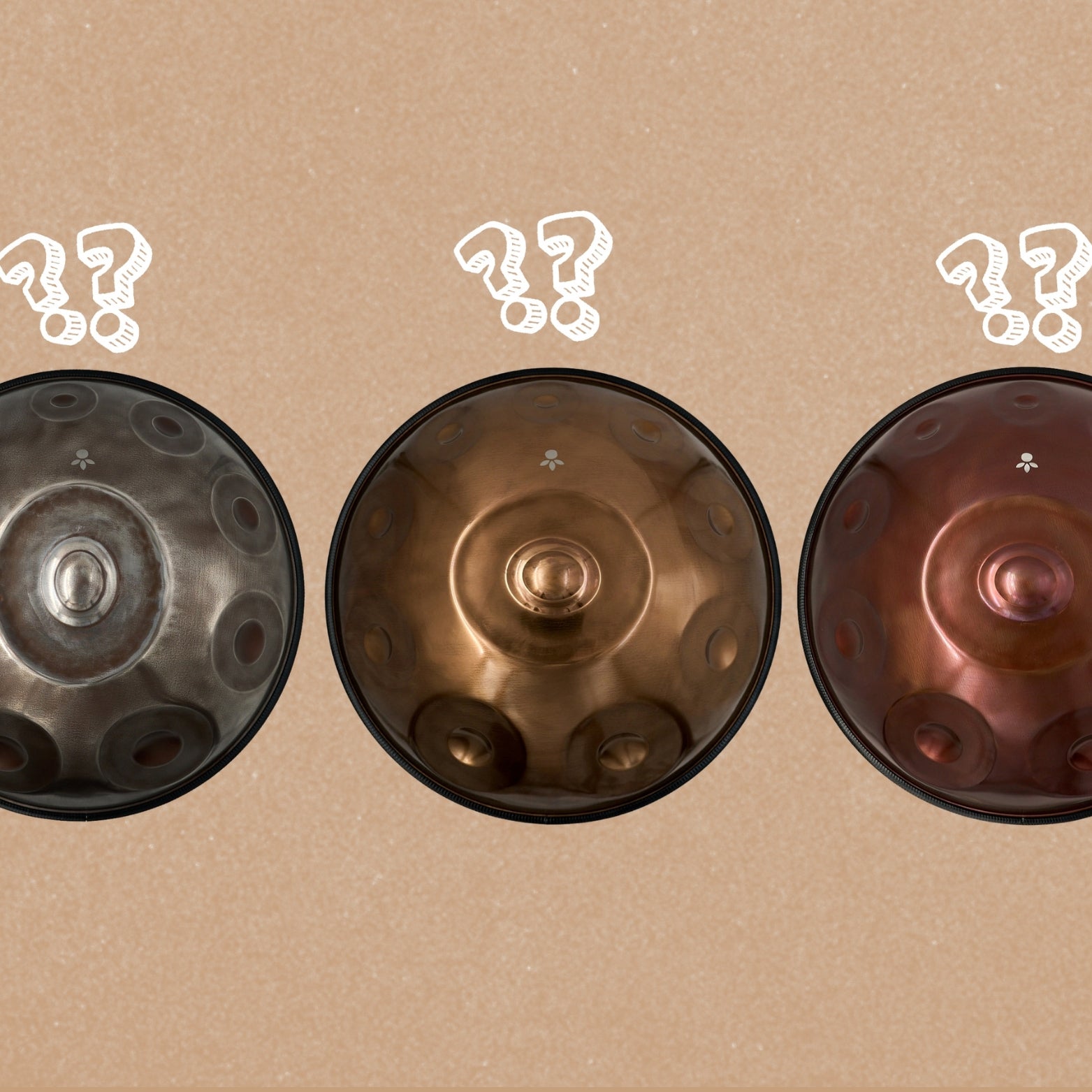
We hear this question constantly: "Is the handpan made of copper?" or "Is the dark/purple/brown handpan made of a different material?"
The short, reassuring answer: Mostly no. In many cases, the color is not an indication of copper , nor is it automatically a "different steel," but primarily the result of the finish, heat, and surface treatment .
Handpans are almost always made of steel – not copper. Depending on the maker and series, this is usually stainless steel or a treated steel (e.g., nitrided). Both variants are steel – the difference lies primarily in corrosion resistance, surface finish, and playing feel , not in "copper vs. non-copper".
The typical copper, brown or violet tones usually only arise through finishing and heat treatment – the base material remains steel.
Many handpans do indeed start out looking silvery . However, during manufacturing, the bowls are heated (heat treatment, shaping, sometimes also with a torch/flame – colloquially often referred to as "firing" or "fire finish"). This process creates an extremely thin oxide layer on the stainless steel. Depending on the thickness of this layer, the type of light reflected changes – resulting in typical tempering colors : from gold/copper through brown to violet/blue .
Important: This is not "paint," but a surface reaction . Therefore, even two handpans made from the same steel can look different – because temperature, duration, and heat distribution are never 100% identical.
Even with stainless steel, the color can vary – regardless of the material itself. Some instruments are heated to higher temperatures, polished differently, or treated differently. Some have additional coatings. That's precisely why appearance alone is not a reliable indicator of material quality.
Besides stainless steel, there are handpans made of nitrided steel (a thermochemical surface hardening process in which nitrogen is introduced into the surface). This is not a "color," but rather a modification of the outermost layer of the material – often resulting in a darker, more matte appearance.
This means that sometimes "dark" is indeed an indication of a different treatment – but not in the sense of "copper", but rather in the sense of a surface process .
Nitrid-coated handpans often sound drier, shorter, and more percussive —with a clear, "earthy" attack and less sustain. Many players appreciate this because it allows fast patterns to remain more defined. At the same time, stainless steel is now considered by many to be the modern standard because it often sounds warmer, rounder, and more aesthetically pleasing .
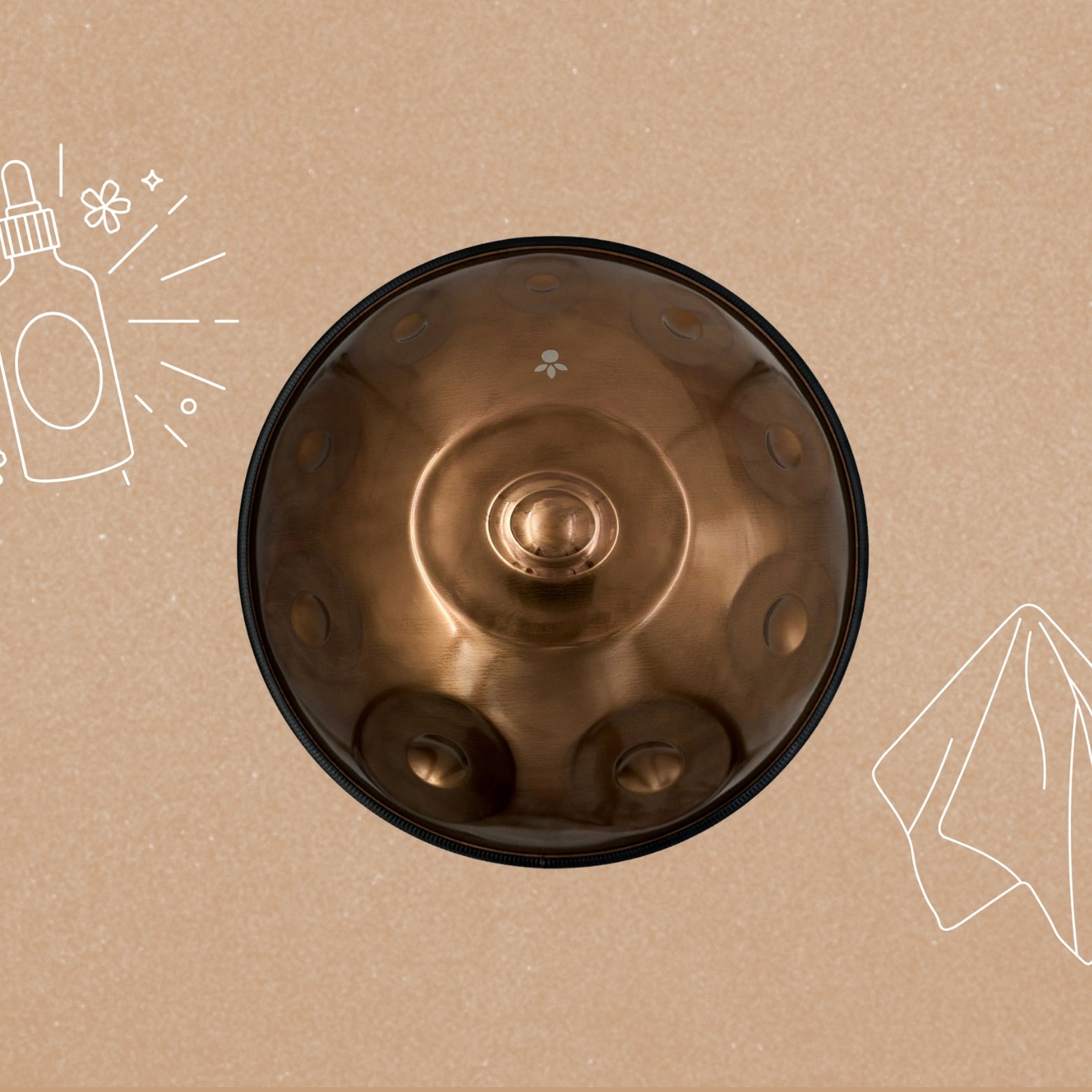
Furthermore, handpans develop a patina over time. Skin oils, care products, humidity, and friction alter the surface visually – without affecting the sound. Many players even like this, as it gives the instrument character.
Partly – it depends on the finish.
If the color is primarily due to this thin oxide layer ("temper paints/heat tint"), strong polishing can reduce the layer and make the handpan appear more silvery again.
However, with some treatments (e.g., nitriding), simply polishing it away is not advisable, because you would damage or alter the treated surface.
Where does the handpan come from?
The handpan is a young instrument .
Their story begins in the early 2000s and is closely linked to artisanal innovation and the further development of existing steel sound instruments .
The basic inspiration comes from the world of steel drums (steel pans) from Trinidad and Tobago.
These tuned tin oil drums were created there in the 1940s .
The idea of playing such a steel sound instrument with the hands , developing new tone field shapes and more closely connecting sound, resonance and playing feel , led to the development of a completely new type of instrument in the early 2000s.
The first models laid the foundation for what is known today as the handpan.
Since then, the handpan has continuously evolved :
- early experiments with steel forming and clay field arrangement
- continuous improvement of materials , tuning methods and sound stability
- increasing refinement of resonance , dynamics and durability
- worldwide spread within a few decades
Today the handpan is played all over the world – from beginners to professional musicians .
The handpan can be found in very different musical contexts :
- as a solo instrument or in an ensemble
- in quiet, acoustic music
- in modern pop, ambient and electronic music production
- on stages , in studios or in private settings
Despite its short history, it has secured a firm place in people's hearts .

Handpan or Hang® – what is the difference?
The term "Hang Drum" frequently appears in search queries, but is not technically correct .
In the early 2000s, a new instrument was developed in Switzerland: the Hang® .
The name is protected by trademark law and refers exclusively to the instruments of the original inventors .
The Hang is considered the starting point of today's handpan movement , but it is not a generic term .
As its popularity grew , similar instruments from other manufacturers emerged, based on the same basic principle, but differing in construction , tuning and sound character .
To clearly distinguish these instruments from the protected name Hang® , the term Handpan became established as a neutral collective term for:
- hand-played steel-string instruments
- with tuned tone fields
- in closed sound systems
Today, Handpan is the internationally used and correct term .
Who is a handpan suitable for?
One of the most frequently asked questions is: Do I need prior musical experience?
The short answer: No.
- No typical music reading required
- quick access to sound
- A motivating sense of achievement from the very beginning
- new sound spectrum
- different approach to rhythm and melody
- easily combined with other instruments
Many traditional instruments initially require tedious learning of fingerings or techniques .
The handpan, on the other hand, responds directly – you strike a field with your hand and a sound is produced. This leads to quick success .
Even without knowledge of musical notation, you can improvise for hours . Of course, it still takes practice to play fluid patterns or complex rhythms, but the learning curve is gentler .
The handpan does not present high barriers to entry .
She invites, rather than demands .
How do you learn to play the handpan?
Playing the handpan often doesn't mean playing classical pieces – although that is of course possible.
It's more about the interplay of rhythm, melody, harmony - dynamics and tempo.
Both are possible – and depend heavily on your own goal .
Alone:
flexible, personal, at your own pace
Instruction:
structured approach, faster progress, targeted feedback
Realistic expectations are important.
Anyone who wants to master the handpan at a high technical level needs – as with any instrument – time, practice and continuous engagement .
At the same time, one of the handpan's particular strengths lies precisely in its simplicity .
Even with just a few clear movements, you can play harmonious rhythms , simple sequences of notes and flowing soundscapes that are touching without being complex.
Often, the greatest musical depth arises precisely there:
not through virtuosity , but through reduction, timing and conscious listening .
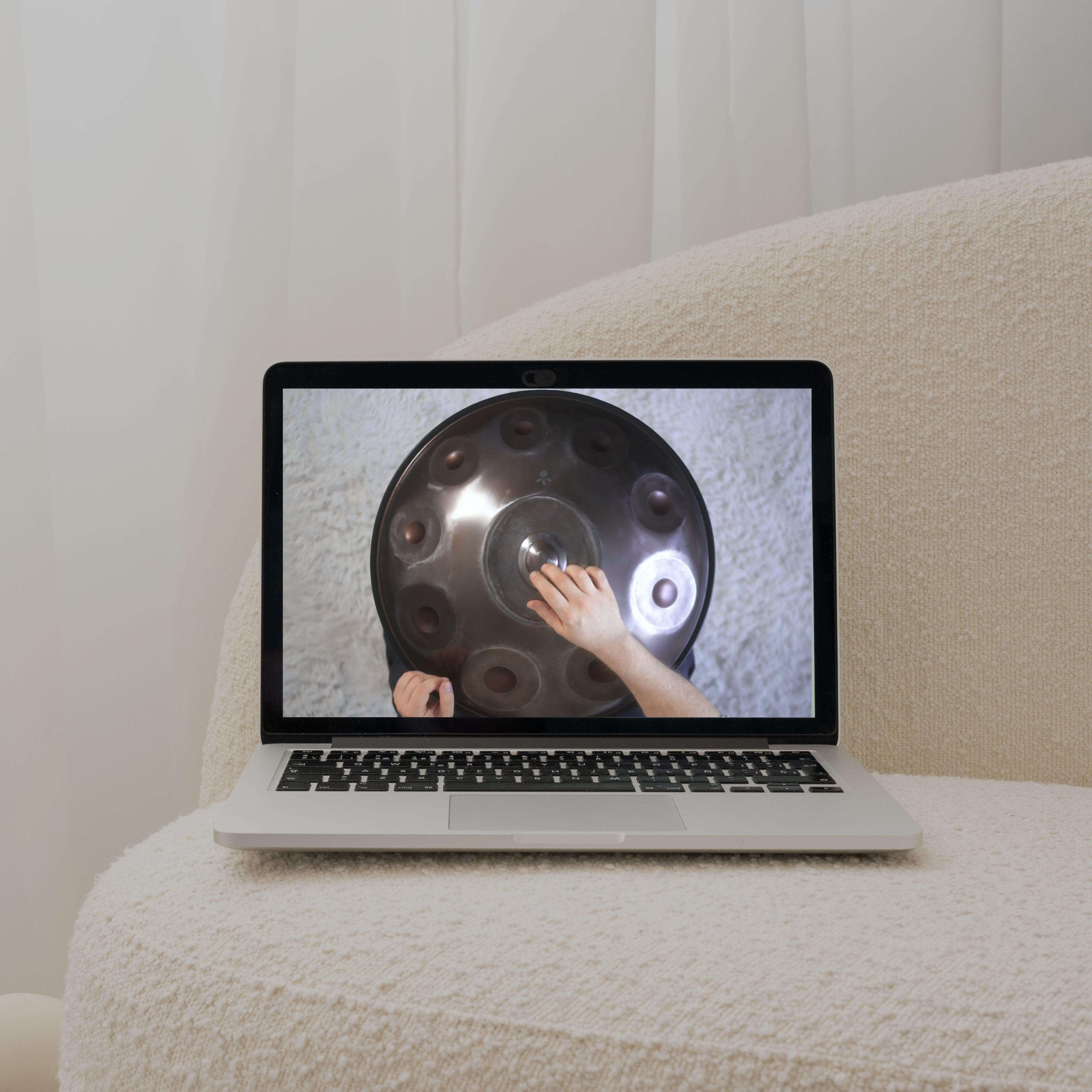
Those who wish to delve deeper into this path – whether intuitively or in a structured manner – will find accompanying support in our handpan courses .
The content is structured in such a way as to provide guidance without restricting one's own musicality: technique, rhythm, feel for the game and musical understanding grow together step by step.
When you purchase a handpan through our handpan shop, access to these courses is included .
It is part of our understanding of accompaniment: not just passing on an instrument, but also providing the space to truly discover it .
Conclusion – why the handpan is more than an instrument
The handpan combines rhythm, melody, and sound in a way that is immediately accessible . It requires no prior knowledge , no theory , and no performance-oriented mindset .
She invites
for listening .
For discovery .
Playing without a fixed goal – and that is precisely where its special strength lies.
Furthermore, the handpan creates something that has become rare in instruments: connection .
Connection with one 's own hearing , one 's own pace , one 's own attention – and also with other people .
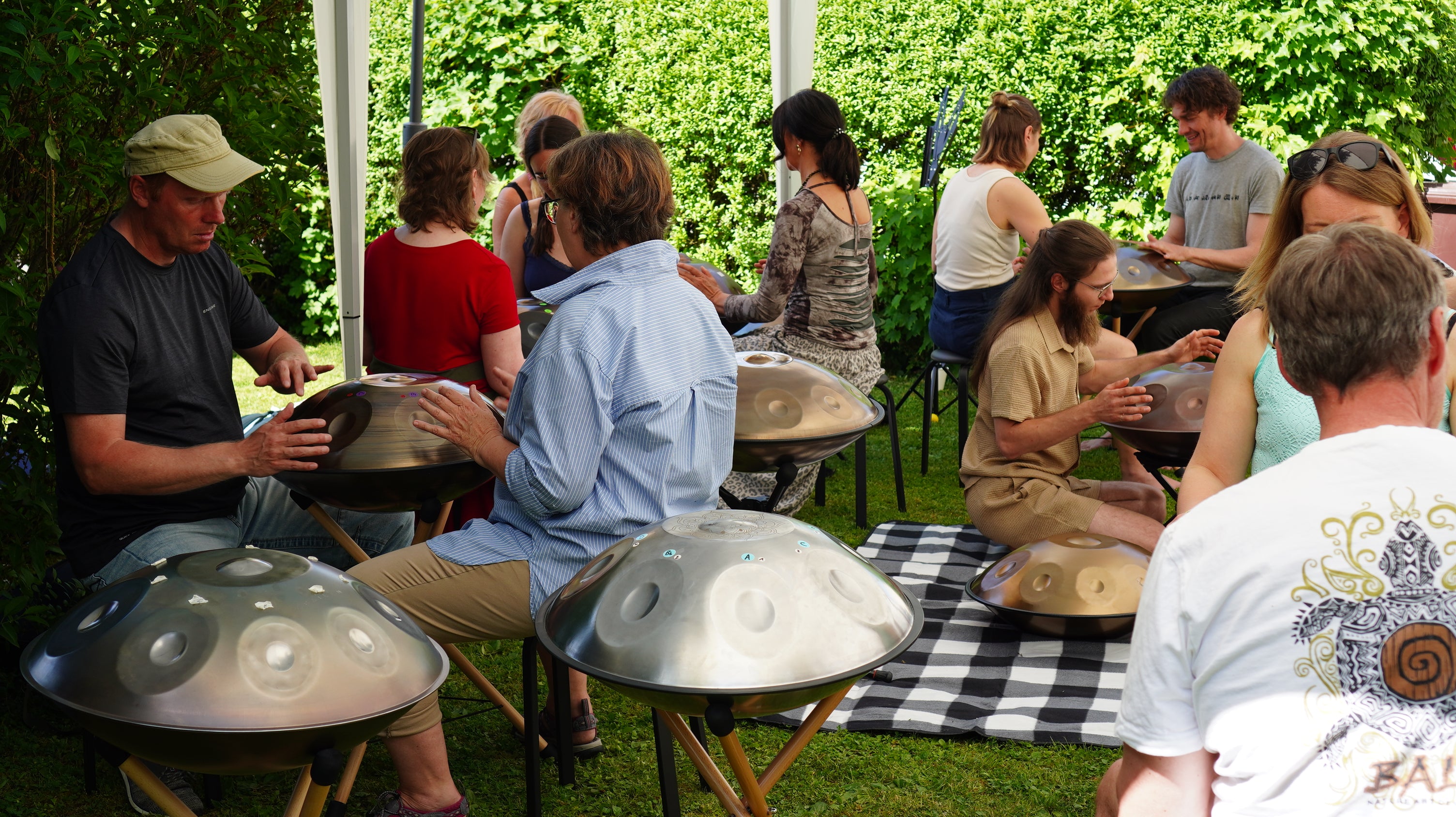
Playing together often happens spontaneously , without prior agreement, without sheet music, without hierarchy.
Meeting spaces have quickly developed around the handpan:
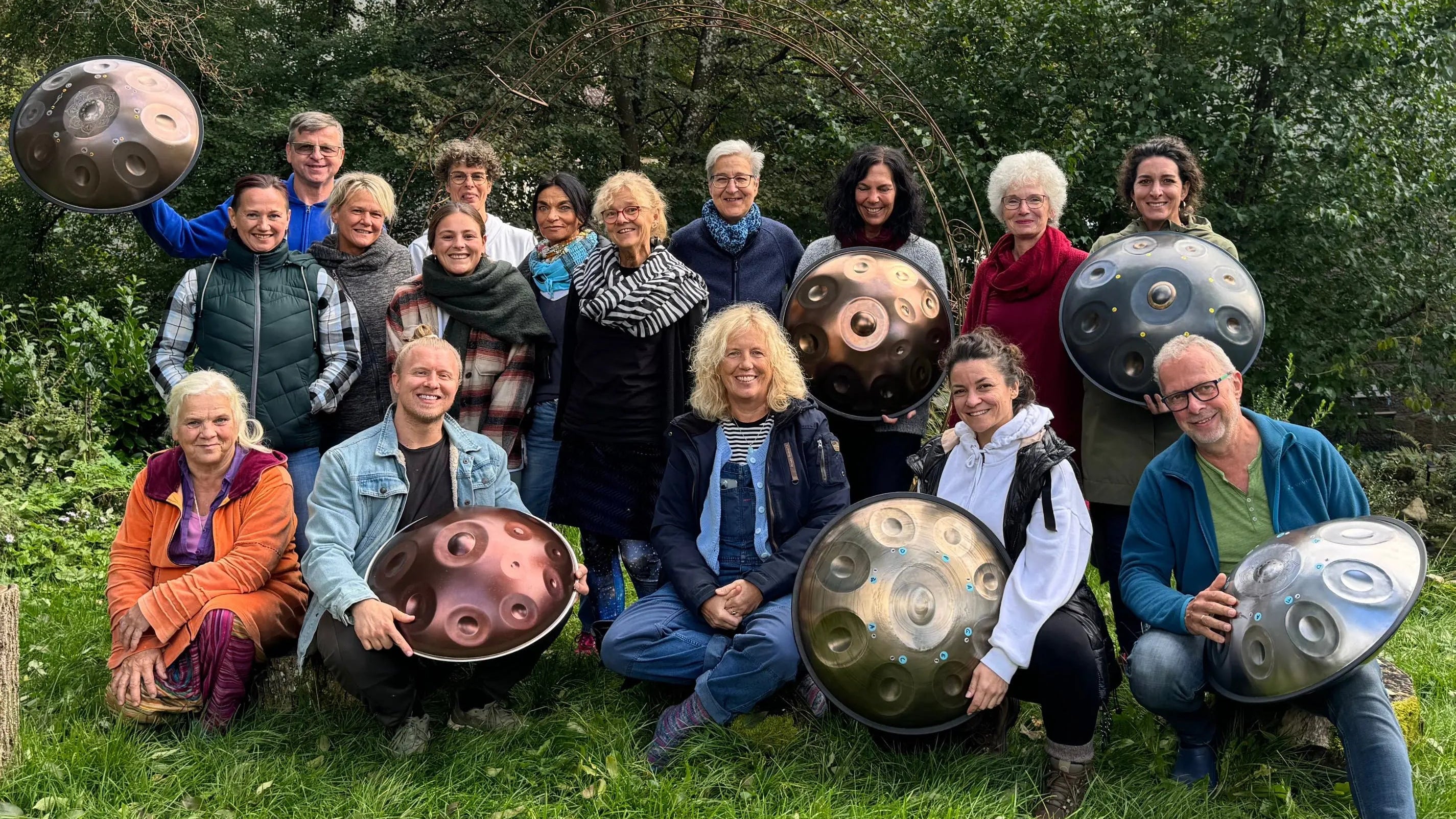
Meetings , workshops , festivals and retreats where the focus is less on perfection and more on the shared experience of sound .
The instrument does not act as the focal point , but rather as an invitation .
Those who are interested in the question "What is a handpan?" are often looking for more than just a new instrument .
Perhaps one is looking for a new way to experience music – and to oneself , alone or in shared sound with others .
Further reading