Handpan Care: Basics, Storage and Protection in Everyday Life
This way your instrument stays beautiful, stable – and sounds the way you love it for a long time.
A handpan is a handcrafted instrument made of steel – making it both practical for everyday use and sensitive to certain environmental influences. With a few simple habits, it will remain beautiful, stable, and pleasant to play for a long time.
This article provides a clear, practical overview of handpan care : what you should pay attention to in everyday life, which warnings are really relevant (sun, moisture, storage, jewelry, transport) and how to protect your instrument effectively.
Steel reacts. Not dramatically – but noticeably, if you use your instrument for a long time. Moisture, sweat, salty air, strong temperature fluctuations, and friction can leave their mark over time. Many of these are purely cosmetic. Some can be avoided if you are aware of the typical risk factors.
Handpan care therefore doesn't mean constantly "having to do something," but above all: handling it wisely . The goal is simple: less risk of rust, fewer unnecessary scratches – and an instrument that feels good for years to come.

Basic skincare at a glance
Intense heat is particularly detrimental to handpans because the steel and surface react to it: the instrument can become very hot, care/finish layers can visibly change, and condensation can form during temperature changes (moisture + time = risk of rust – especially if you immediately pack it up afterwards).
Playing in the sun: Playing outdoors is perfectly fine – ideally in the shade . If the handpan gets very hot in direct sunlight, it's best to let it cool down briefly and not continue playing on overheated metal.
If you do need to leave them briefly in the car during the summer:
- Always keep it in your bag , and insulate it with a thick blanket.
- in the trunk or completely concealed (not on the back seat)
- Park in the shade if possible / use sun protection
Then briefly open the bag, allow it to acclimatize , wipe the surface, and only then close it again.
Important: Do not "quickly cool" with water – let it cool down naturally.
Steel reacts to temperature: it expands slightly when heated and contracts when cooled . As a result, a handpan can feel and sound different – usually only subtly – until it is "back up to temperature".
-
Very cold: The sound often seems somewhat more direct/strict , sometimes less "open". The response can also feel slightly more sluggish for a short time – especially if the hands are also cold.
- Very warm/hot: The sound may subjectively seem softer and less focused. In direct sunlight , a handpan may temporarily sound unusual or slightly "off" because the material heats up considerably. This is normal for steel instruments and usually disappears once the instrument cools down naturally in the shade .
- Alternating temperatures (cold → warm / warm → cold): The instrument may react unusually for the first few minutes. After that, the playing feel usually stabilizes on its own. Do not "warm up quickly" on a radiator – allow it to acclimatize naturally.
Practical tip: After strong temperature changes, give the handpan a few minutes to settle down – then it will sound and play as usual.
Even though many handpans are made of stainless steel , "rustproof" does not mean "invulnerable." Stainless steel is significantly more resistant , but can still develop small rust spots/discoloration over time due to moisture, salt (sweat/sea air), and exposure to time – often more superficial ("flash rust") than actual damage.
Playing outside is perfectly fine – but please don't "bathe" unnecessarily:
You sometimes see videos of handpans being played by a lake or in water. Visually spectacular, but rarely beneficial for the instrument: water (and especially salt water) can get into cracks and openings and cause problems later on.
Practical rule:
If the handpan gets damp: wipe it off , let it dry openly , and only then put it back in its case . This is also advisable after very humid air or heavy perspiration.
Many scratches are not caused by "incorrect play", but by small things:
- Rings
- Metal bracelets, watches
- including zippers or buckles during transport
Even a single strike of a ring can leave a faint mark. This usually has no effect on the sound – but it quickly looks unsightly.
Recommendation: Remove jewelry before playing. This is one of the most effective protective measures available.
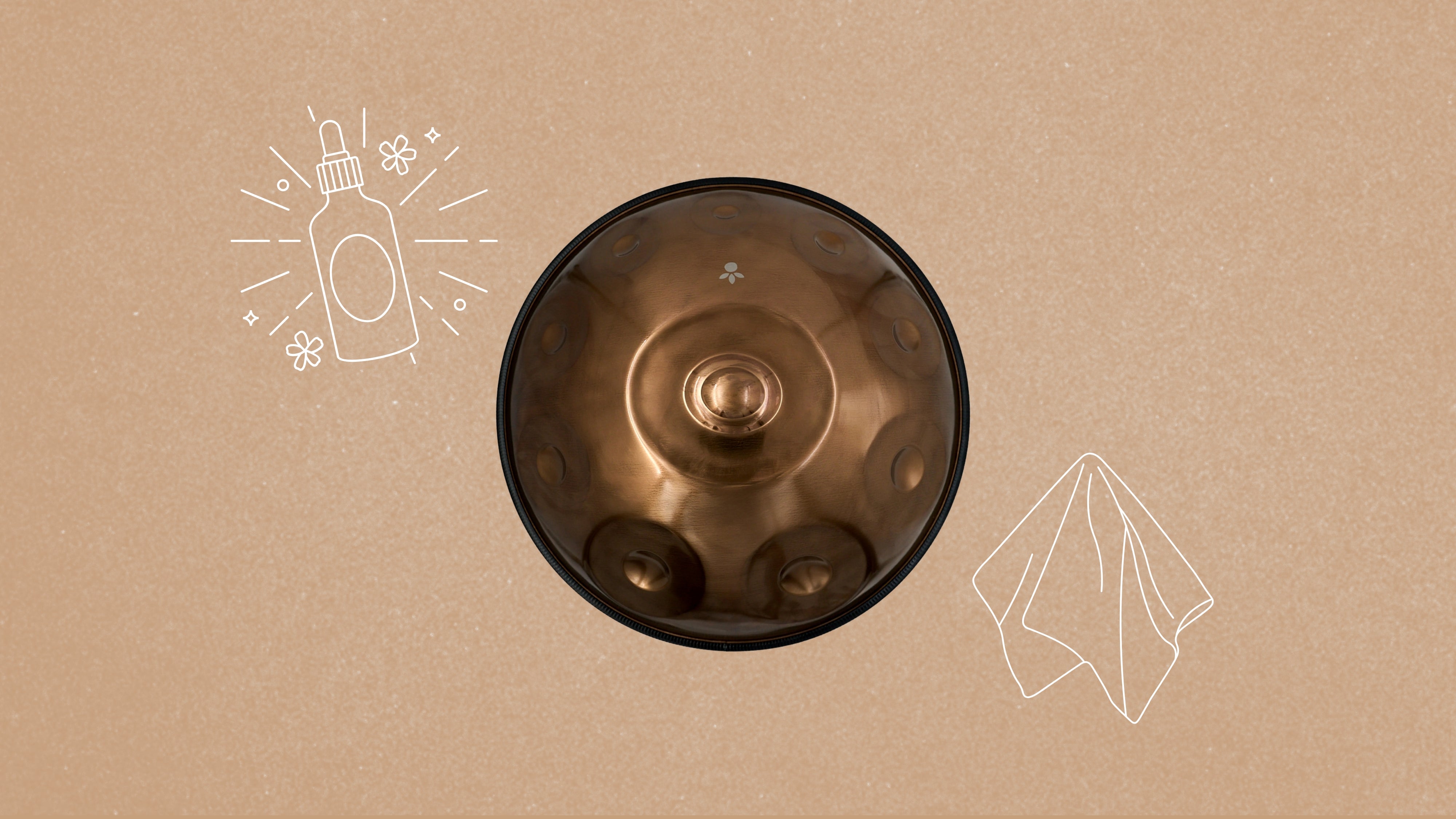
Regular maintenance with a suitable oil can help protect the surface – especially if you play a lot, sweat heavily, or your instrument is frequently exposed to humid air. Important: "More is not better," but rather a thin, even, and clean polish .
Here's how to do it right:
- Wipe the handpan dry and clean beforehand.
- Apply a small amount of care oil to the handpan
- Spread it out thinly with a microfiber cloth (do not get it "wet")
- Then polish thoroughly until nothing is smeared.
For this purpose, we have developed a premium handpan care oil that is specifically designed for handpans: It provides reliable protection, is easy to apply, and leaves no sticky residue when properly polished.
The most reliable care is habit:
Wipe the surface once with a soft microfiber cloth after playing.
This is the most important step, especially if you sweat a lot or play outdoors.
Many people do it like a little ritual: last note, hands down, wipe, done.

Storage & Transport
Many handpans have 8+1 (9 notes) or 9+1 (10 notes) . The "+1" usually stands for the ding (the middle note).
Dry, temperature-stable, without extreme conditions
The ideal storage solution is unspectacular:
- dry
- no direct sun
- no strongly fluctuating temperatures
- not in damp basements
Store in a bag or openly?
Both can be correct – depending on the everyday situation:
Storing it in a bag is practical if the room is dusty or if you are transporting a lot of things.
Storing instruments in the open can motivate you to play more often – provided the room is dry and the instrument is stable.
Important: If the handpan is moved from cold to warm, condensation may form. In this case, allow it to acclimatize briefly, wipe it off, and only then close/pack it away.
Many handpans don't suffer their biggest "ouch" moments while playing, but rather when they're out and about : door frames, car doors, stairs, narrow hallways. A good bag provides protection – but how you use it is just as important.
Make sure that:
- The handpan does not "work" in the bag (no play, no rubbing against hard parts)
- so that it doesn't slide around loosely in the car (best secured firmly between luggage or on the seat)
- You keep enough distance from edges, doors and railings when carrying the garment.
Especially when carrying it on your back, an extra tip is worth mentioning: You need more "radius" than you think. Many people bump into things with the bag when turning or going through narrow passages – like a small turtle shell . Take a step slower, go through doors and around corners consciously – and you'll save yourself a lot of trouble later.
Patina & Finish
Changes in the surface are often normal.
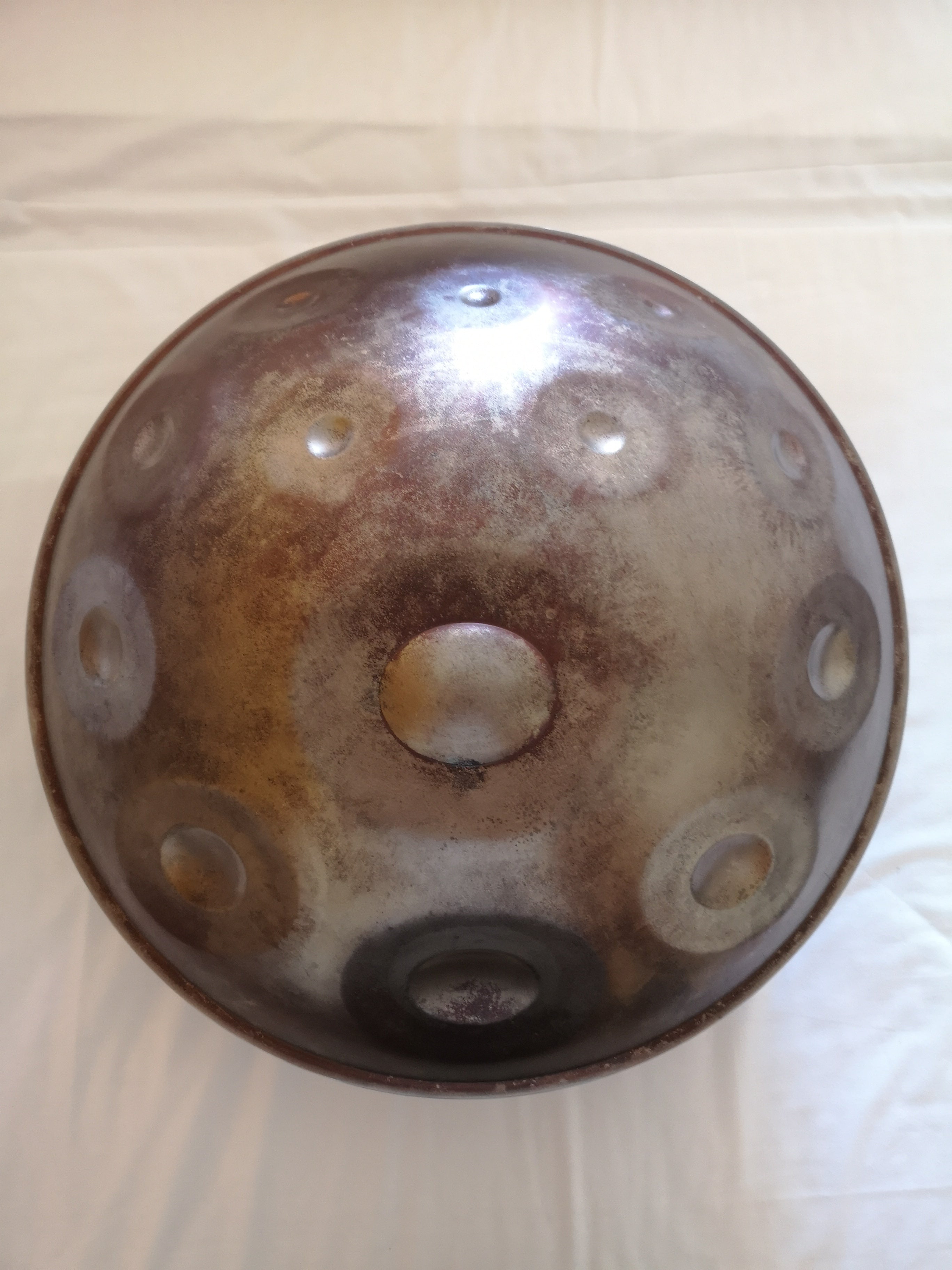
One point that worries many: On some handpans – even in the higher price range – the surface can visibly change over time. The patina becomes uneven, areas appear duller or more "used". Sometimes it looks as if the finish is changing or "peeling off" in places.
It's important to note that this is often purely a visual effect . The sound remains completely unchanged in many cases. Many players even perceive such marks as character – similar to other instruments that develop their own history over the years.
Of course, if you suddenly notice very significant changes or are unsure, it's worth having a quick check with the supplier. But generally speaking, a visual change doesn't necessarily mean that something is "broken"—often it's simply the result of use, environment, and material reactions.
Conclusion: Handpan maintenance is less work than many people think.
You don't need a complicated routine – just a few good habits. If you pay attention to these points, you're already doing a lot right:
- do not "forget" in heat or wet conditions
- Wipe briefly after playing
- Avoid sources of scratches (rings, metal parts, rough surfaces)
- and make sure that the handpan is standing securely – protected from falls, bumps and wobbly surfaces.
This way, your instrument will remain stable and beautiful in the long term – without maintenance becoming a project.
And then the focus can be back where it belongs: on playing, on listening, on the sound.
Further reading