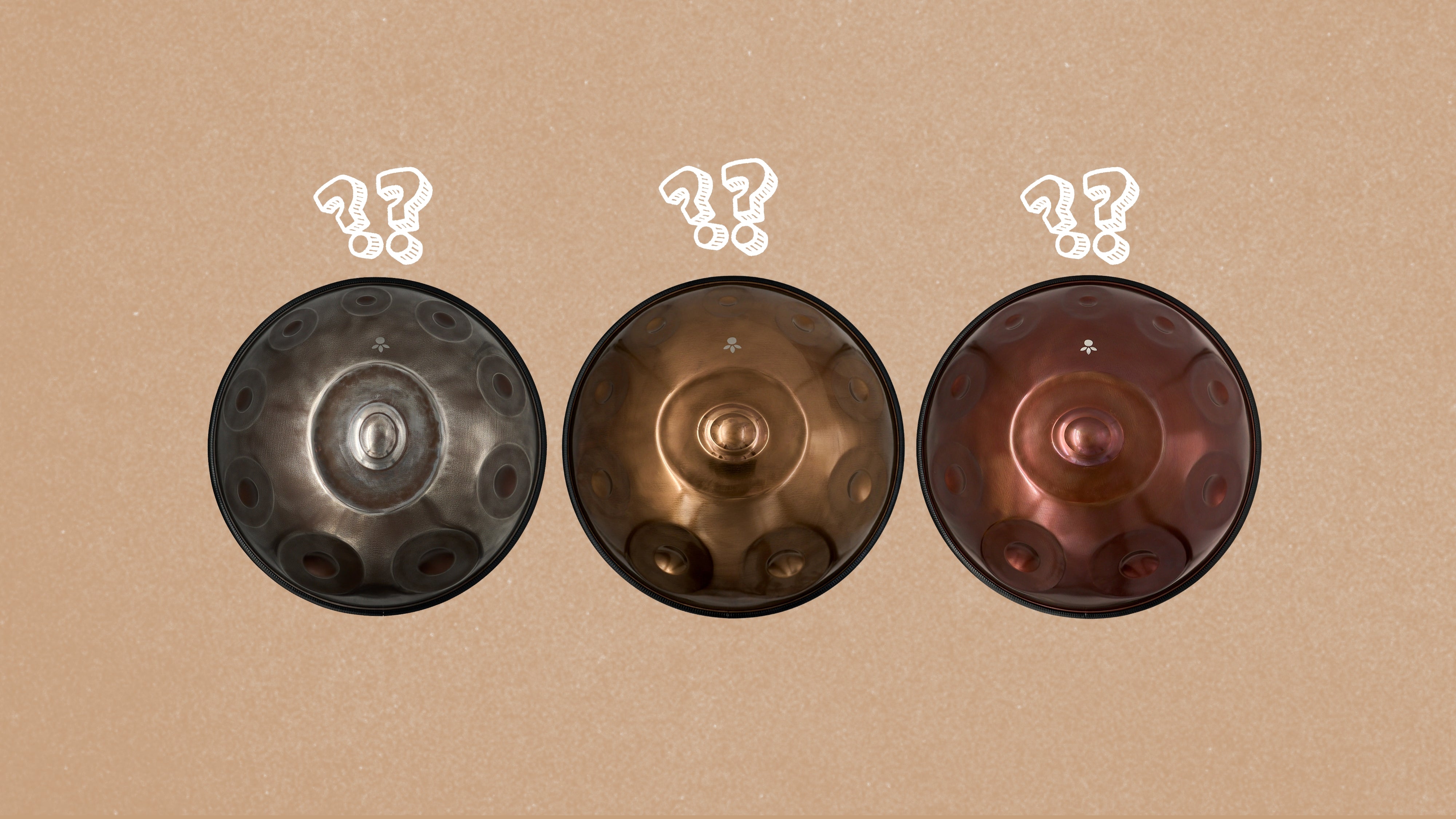
Buying a handpan – what should you pay attention to?
Buying a handpan is rarely a "normal" shopping experience. Most people aren't simply looking for an instrument – they're looking for a sound that touches them. And that's precisely why the market can be confusing at first: lots of terminology, huge price differences, beautiful videos, promises – and often little guidance.
This article is a clear guide for anyone who googles "buy handpan" and is wondering:
How can I recognize quality? What mood suits me? How can I avoid making the wrong purchase?
A handpan is not an industrial product, but a handcrafted steel instrument . Small differences in material, shape, and tuning significantly alter the sound. At the same time, the prices are high – and many beginners are not yet able to reliably assess quality.
Typical traps:
-
Extremely cheap offers often give a poor impression of the instrument.
- Word labyrinths (Kurd, Celtic, Pygmy, 432 Hz, "Master", "Pro") do not replace real criteria.
- Lack of advice leads to bad purchases and frustration.
The good news: A clear checklist makes it very quick to sort out many things.

Mood (scale): Which one suits you?
Every handpan has a fixed tuning – you can't retune it like a guitar. The scale determines which notes are available to you and how the instrument "feels" musically.
Two questions are crucial when making a purchase:
- intuitive play / relaxation / soundscapes
- Learn rhythm and melody
- playing with others (jam, lesson, ensemble)
- record / play along to backing tracks
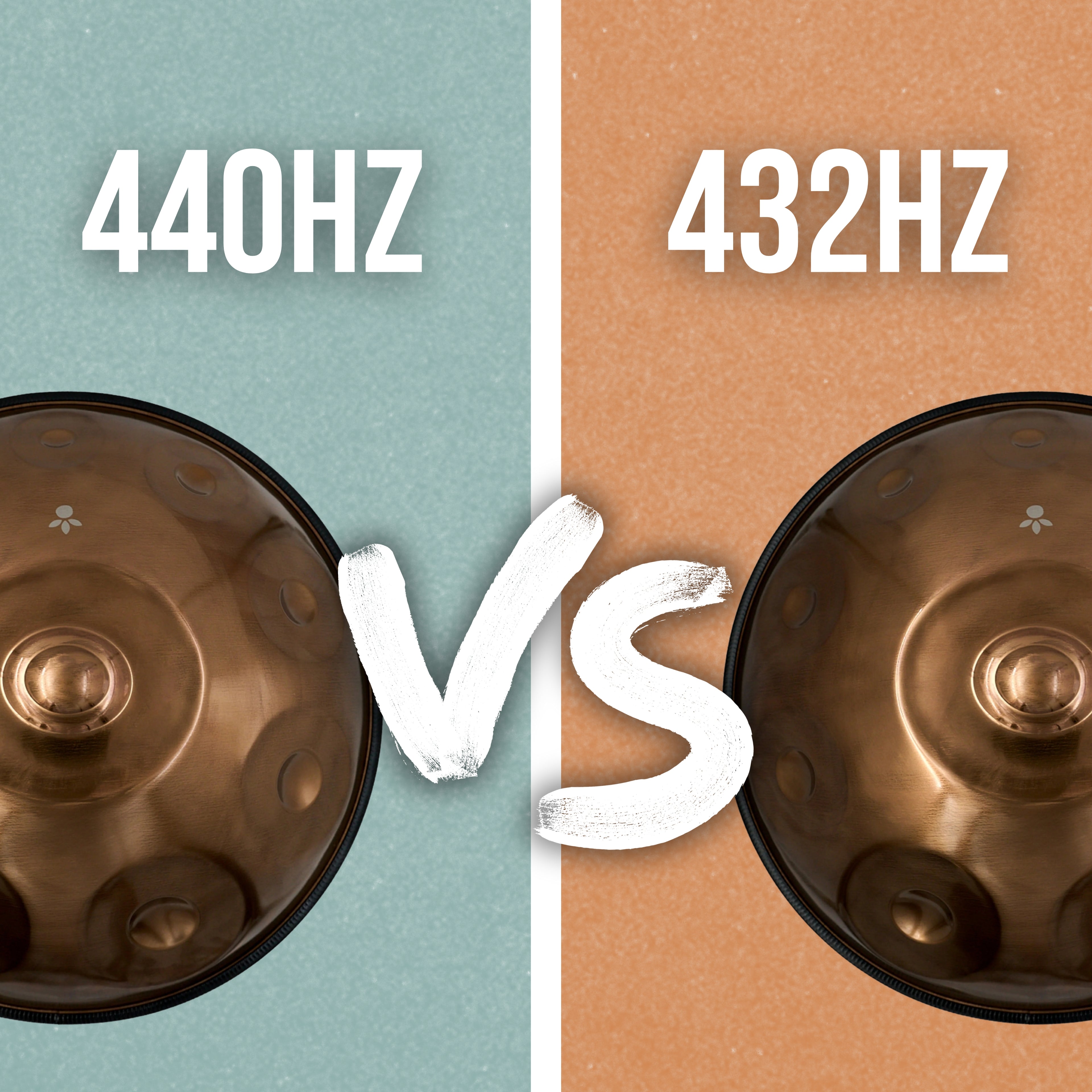
- 440 vs. 432 Hz: What does that mean – and what is really important?
Beginners often benefit from scales that:
- are clear
- feel right quickly
- frequently occur in learning materials
Why D Kurd is so often recommended:
Kurdish is very widespread and therefore a "common denominator" in tutorials, courses, and workshops. You can more easily find learning content, examples, and practice methods without constantly having to rethink your approach.
If you want to delve deeper into moods: Our Scale Finder (scale guide) is ideal for this – so that terms like Kurd, Amara, Celtic or Pygmy don't sound like a foreign language test.
Kurdish is often the simplest starting point because there are the most tutorials available for it. Celtic/Amara can be ideal if you're looking for exactly that sound. You can find more guidance in the Scale Finder .
Not everyone wants to learn handpan in the "classic" way, follow tutorials, or think within fixed course structures. Many are primarily looking for a sound that brings peace , that sustains , and that sounds harmonious with just a few movements – entirely for themselves.
Dreamy, atmospheric scales can be particularly well-suited to this approach because they often have a very "broad" feel and create a warm sound. An example of such a starting point is a C# Pygmy scale (e.g., as a compact 9-note variant), which is well-suited for quiet patterns, slow melodic phrases, and soundscapes.
If the focus is strongly on sound work/meditation/sound healing setups , then choosing an instrument specifically designed for this purpose can be beneficial – for example, handpans, whose sound character and tuning have been specially developed for calm, pleasantly resonant sound work. Our Sound Healing series is currently being developed precisely in this direction: high-quality instruments tuned to 432 Hz with carefully selected scales, optimized for gentle soundscapes and meditative applications.
Important to note: there is no single "calm scale" that exists in itself. Every tuning can sound calm or powerful – this depends primarily on playing style, tempo, dynamics, and attack. What's crucial is that the sound of your scale truly resonates with you and that you enjoy spending time with it.
If you are unsure about terms like Kurd, Amara, Celtic, Pygmy or Aegean : That's perfectly normal.
We have created a free Scale Finder for this purpose – a compact guide that clearly explains the most common handpan tunings, classifies differences and helps you find your sonic direction.
Note: The Scale Finder is currently under development and will be expanded step by step.
→ Go to the free Scale Finder
Tonal range: 9, 10 or "Extended" – which makes sense?
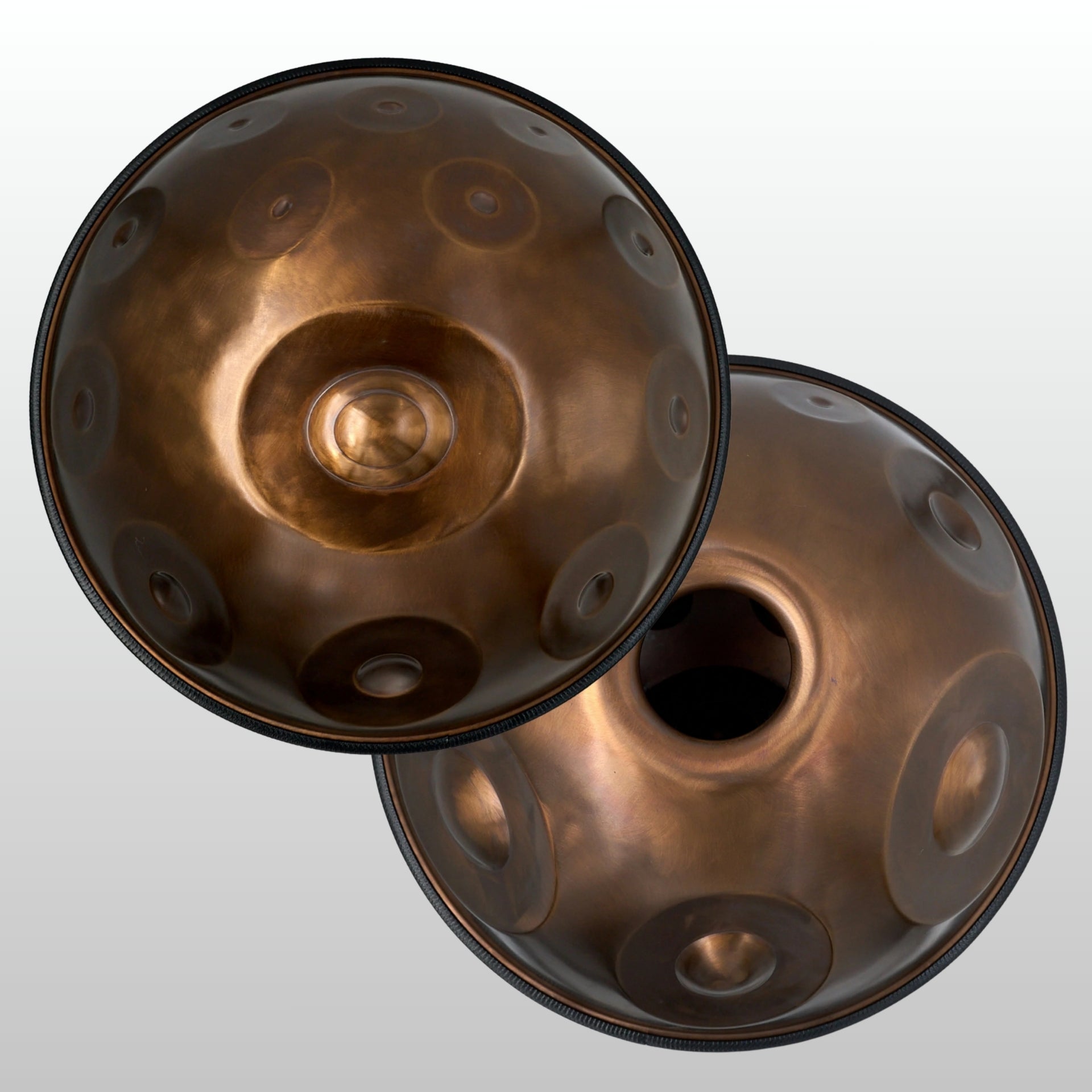
Many handpans have 8+1 (9 notes) or 9+1 (10 notes) . The "+1" usually stands for the middle note .
A 10-string can do everything a 9-string can – only with an additional note as a bonus.
More tones generally mean more possibilities, but can also seem less clear at the beginning while you are still developing your orientation, ear and feel for playing.
Extended models (e.g., with bottom notes) expand the tonal range – often for:
- Basslines
- larger melodic arcs
- more expression in the long term
They are not a must for getting started, but can be useful if you are consciously planning for the long term and the budget allows.
A typical pattern in the market is instruments like the E Amara 12 , E Amara 16 , or other variants that fall somewhere "between" the standard and the fully extended version. Many people buy these hoping to get "a little more" without immediately investing in a large extended model.
Experience has shown that this often leads to a problem: it feels incomplete later on.
Not because these handpans are bad – but because over time you realize that the tonal range is actually designed to be even wider. Then you see players with an E Amara 20 , realize that certain musical avenues (bass lines, longer melodic phrases, additional chord colors) would be possible – and you're annoyed that precisely these notes are missing.
If you're going to extend your life, do it consciously. Many people are more satisfied in the long run if they either:
- Keep the entry point clear and easy to navigate (standard model), or
- Invest directly in a fully equipped Extended version if that's exactly what they want and the budget allows.
However, there is one exception that, in our view, really makes sense in practice: D Kurd 12 and D Kurd 14
The reason: Here, notes are not added arbitrarily , but in a way that expands the sound harmonically and musically in a meaningful way . You get more expression, more transitions, and more possibilities – without the instrument losing its clear, learner-friendly character.
Especially for beginners, the D Kurd 12 and 14 can be a good bridge:
- D Kurd remains the basis (and therefore compatible with a great deal of learning material)
- At the same time, the tonal space opens up noticeably.
- without having to directly invest in and deal with the complexity of a "full-size" extended model
This isn't mandatory – but many people would like two additional bottom notes or more melody notes in the upper register for the standard D Kurd. Requests for precisely these kinds of extensions are becoming significantly more frequent.
Build quality, feel & sound
When buying a handpan, people often talk about "perfect tuning"—sometimes as if it were the most important proof of quality. Of course, accurate tuning is important. But with handpans, the truth is a bit more complex.
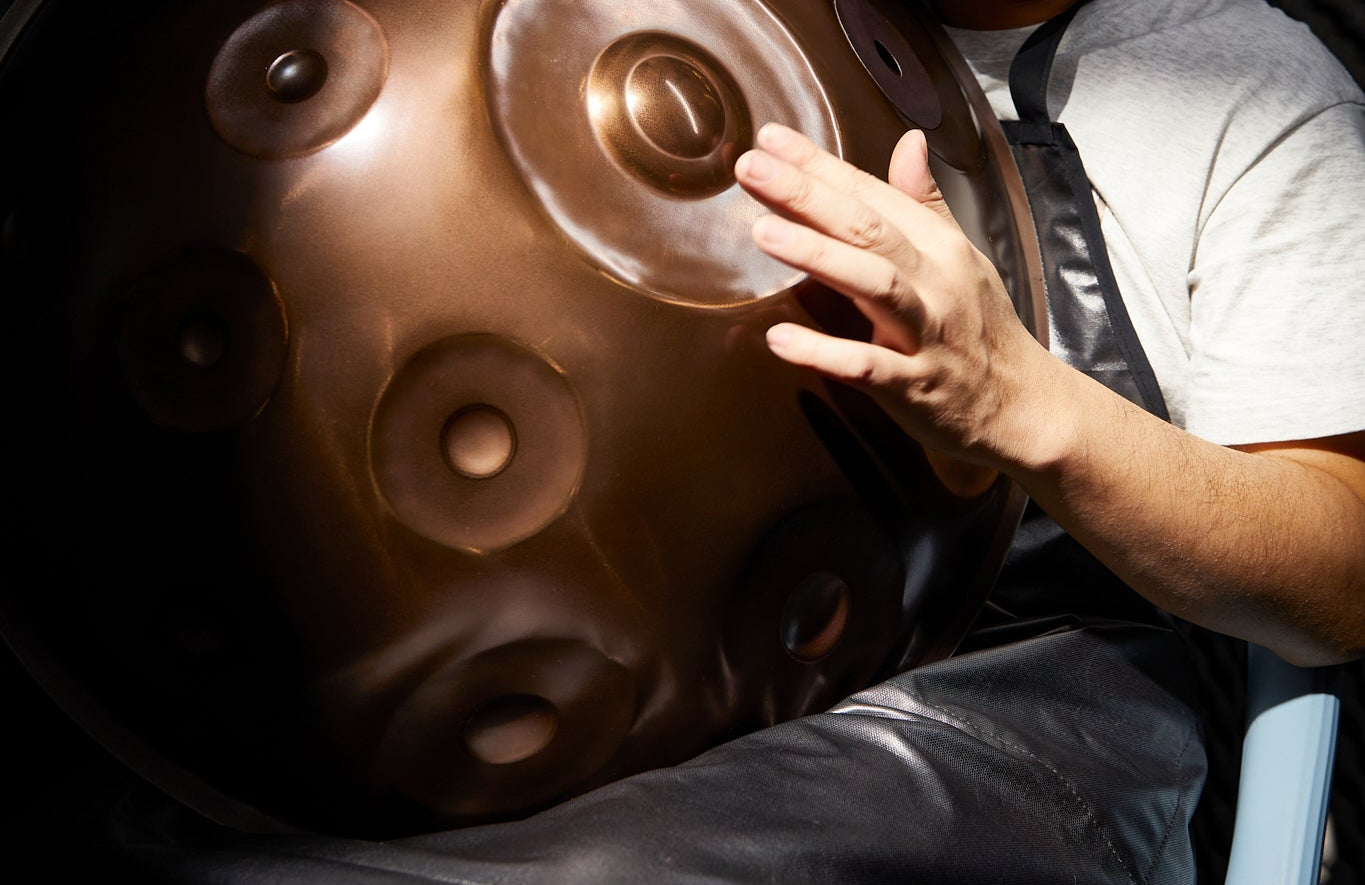
Two handpans can look similar on paper – and yet play completely differently. This is because with handpans, it's not just the tuning that matters, but also how the instrument responds , how evenly the tone fields react, and how stable the whole thing works together in terms of sound.
Important: Especially at the beginning, it's perfectly normal that not every note is "right" right away. Many beginners need some time to find the right touch, hand position, and dynamics.
Therefore, instead of asking yourself "Can I do that already?", ask yourself:
- Does the instrument sound clear and resonant in the sound samples (even when played quietly)?
- Does it seem as if even gentle touches produce a clean tone – or do you have to play very hard for anything to "work" at all?
If possible, this helps enormously:
- a brief comparison with a second instrument
- or feedback/check from someone who has been playing for a while
In short: The feel of the instrument is not about having to be able to do everything immediately – but about the instrument supporting you in your learning instead of hindering you.
Handpans are instruments made of steel – and steel reacts to its environment. Therefore, a handpan can easily change over time in everyday use, for example due to:
- Temperature changes (warm/cold)
- Transport and vibrations
- very hard attacks
- Materials and construction
A good handpan is characterized by remaining stable during normal use, not noticeably "running away" when playing together, and having controlled, clean overtones.
Important practical tip: Sun & heat can have a short-term "disruptive" effect.
Many beginners don't know this: Please do not play the handpan in direct sunlight.
The metal heats up and expands slightly – which can temporarily make the sounds a little off-key or unusual. In many cases, this is neither harmful nor a cause for panic.
Once the instrument is back in the shade and cools down, it often resets itself. Nevertheless, it's best to avoid direct sunlight and intense heat – this is normal for metal instruments.
Similarly, cold temperatures can alter the perception: On some days, a note might briefly feel different, even though the handpan is fundamentally sounding fine. It's important to evaluate such impressions only after the instrument has returned to normal room temperature .
In short: A handpan is alive and reacts – the crucial thing is that it remains reliable in everyday life and that you are not left alone in case of emergency.
Many are surprised to find small scratches, fine lines, or minimal visual irregularities on a brand-new handpan. This is perfectly normal – handpans are shaped, hammered, and finished by hand . Depending on the tools used, the finish, and the angle of light, these small marks can occur, but they do not affect the instrument's function.
The classification is important: what matters is sound, feel and tuning stability – not absolute “industrial perfection” in appearance.
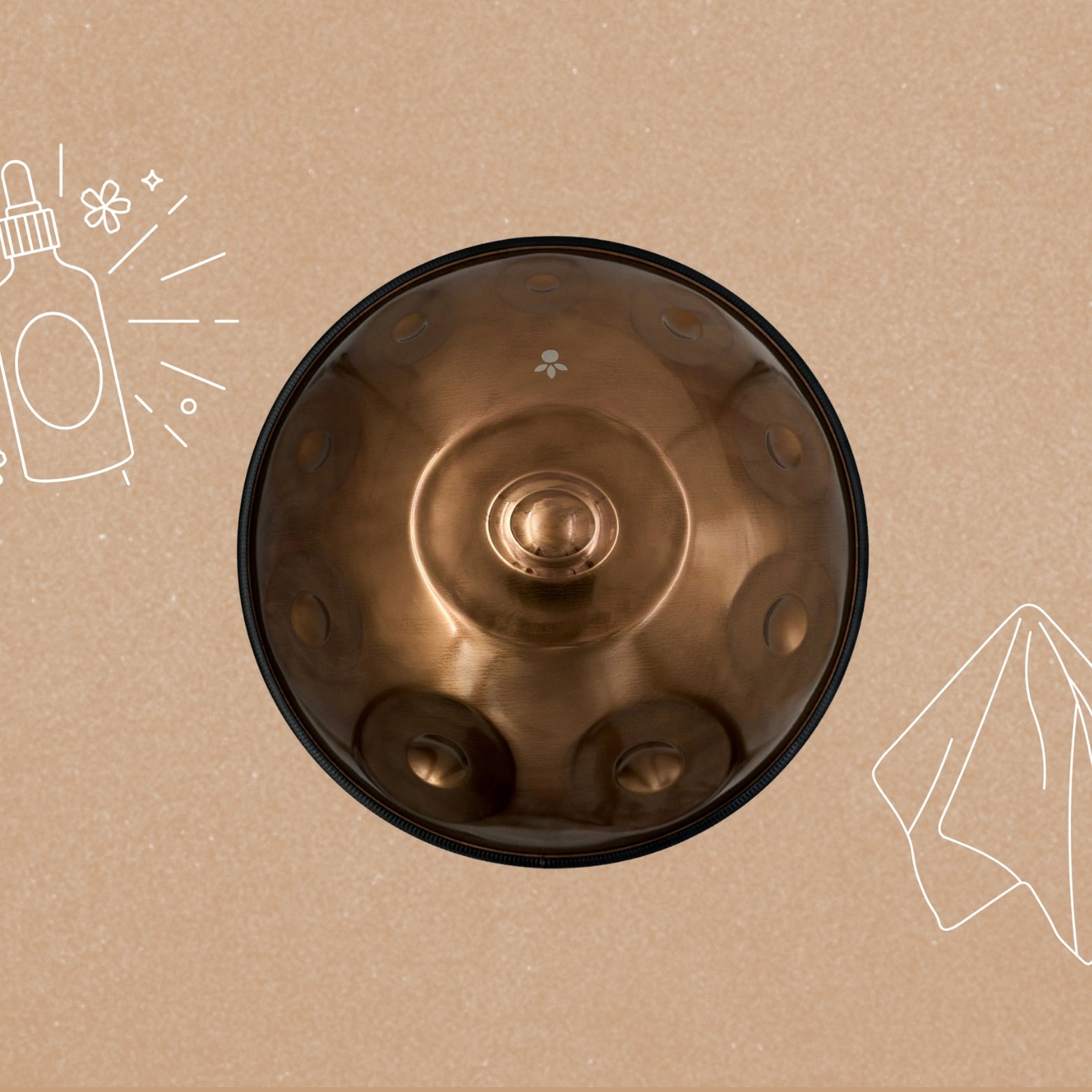
Besides the mood, the surface of a handpan can also change with everyday use – especially because steel reacts to touch. Fingerprints, skin oils, and sweat can leave slight marks or subtly alter the look over time, depending on the finish.
In most cases, this is not a quality defect , but normal wear and tear – similar to other metal instruments. Those who wish to minimize this can briefly wipe the handpan with a soft cloth after playing and store it in a dry place.
If the only goal were to precisely measure every note to a single measurement, many extremely inexpensive instruments would be considered good handpans. In practice, however, they often sound harsh, flat, unstable, or unbalanced.
The reason: With a handpan, it's not simply a matter of tuning "one note". Each tone field consists of several musical layers:
- Fundamental tone (what you perceive as a tone)
- deliberately tuned overtones (typically two important overtones that make the sound rich and harmonious)
- and the interaction with the entire resonating body of the handpan
When you strike a note, it's never just that one note that vibrates. An entire system always vibrates along with it: the overtone series, resonance, decay – and the reaction of other sound fields.
The real art: balance in the overall instrument
With handpans, there's another important point to consider: A note on the tuner often doesn't "sit" exactly at 0 cents like a guitar string – and that's not automatically a mistake.
In short: A cent is a very small unit for pitch differences – 100 cents correspond to a semitone . So if a tuner displays, for example, +10 cents , the pitch is only minimally higher than the reference value.
The reason: A handpan produces a very complex sound when struck – with simultaneously sounding overtones, a lot of resonance, and a lively decay. Many tuners are not optimized for this and react differently depending on the striking technique, microphone, room, and overtone content. The display can therefore "jump" or show values that would be much clearer with a single string tone.
Furthermore, handpan tuning isn't just about "setting the pitch." Each tone field is tuned as a complete sound package —with its fundamental tone and deliberately placed overtones—and always in relation to the entire instrument. An experienced tuning master sometimes makes decisions that don't aim for a single note to sound "perfect" on a measuring device, but rather for the handpan as a whole to sound open, stable, and harmonious .
Therefore, tuners are a tool for handpans – but not a final judgment. What matters is how stable a tone feels, how cleanly it carries – and above all, how the instrument truly sounds when played together.

Our series at a glance: Which handpan is right for you?
Many people ask themselves when buying a handpan: "What is the difference between your series – and which one makes sense for me?"
Here you will find a clear classification: playing feel, sound character, area of application
The Starter Series is designed for people who are buying or renting a handpan for the first time .
Focus: clear orientation, good response, balanced sound – so that learning is fun and the handpan “responds” from the very beginning.
Our starter line is made from premium stainless steel (1.1 mm) - due to the slightly thicker steel than the standard (1 mm), it has a soft, ceramic sound and high tuning stability.
Characteristics :
Clear, warm sound and pleasantly easy to play. Thanks to optimized manufacturing, it's particularly affordable – with the same meticulous craftsmanship as in all our lines. Ideal for anyone who wants a versatile, immediately accessible instrument.
The Studio Series is aimed at players who have already developed some feel for the game – or who want more nuance from the start.
Focus: more control, more dynamism, more freedom.
Our Studio line is made from Arden Steel (1.1 mm) – our specially developed handpan steel that provides stable tuning, warmth, clear overtones and brilliant resonance .
Here you will find a wide selection of scale and extended models , perfect for free playing, recording, performances and creative sessions.
The studio models are tuned by our experienced tuners, who shape each handpan with sensitivity, precision and musical passion .
Ideal for: Players who want to take the next step; Recording; Live; Creative development.
Our HPL Extended series is the step into the wider sound world of the handpan: more tonal range, more depth, more expression – more possibilities for telling musical stories. Larger melodic arcs, additional harmonies, deeper registers, and new transitions open up spaces that a standard model often only hints at.
Important for context: The HPL Extended Series belongs to our Studio Line – and this is precisely where we deliberately set a different standard. While extended models in the industry are often built from 1.0 mm steel (because it's easier to implement), our Extended Series is made from 1.1 mm Arden Steel . This is unusual – and more complex – but offers a clear advantage: greater stability, increased load-bearing capacity, and a more mature sonic foundation , especially in the lower frequencies.
The Master Series is aimed at people who are looking for an instrument with maximum control and sonic maturity .
The focus is on great dynamics (from whisper-quiet to powerful), warmth and depth , a very stable balance between the tone fields and precisely controlled overtones .
Our Master Series is made of thicker 1.25 mm Arden Steel – a material that is considered top- of-the-line in the handpan world.
The harder, more stable steel produces a richer, deeper, more complex sound that unfolds its full power especially in the low notes . Where thinner steel reaches its limits, the Master Pan remains full, balanced, and commanding .
The downside: 1.25 mm steel is a real challenge – even for masters of their craft.
The metal is stiffer ,
The resonances mesh together more slowly ,
and each note needs significantly more time to "speak to each other" perfectly.
On average, tuning a Master Pan takes about two to three times as long as tuning a Studio Pan – even longer for instruments with many notes. That's precisely why only our most experienced tuners work on the Master Series.
After construction, the Master Pan needs a short "break-in" period : The tuning is deliberately set somewhat tight so that it can withstand transport without problems. With the first few hours of playing, the instrument then noticeably opens up – the sound becomes warmer, deeper, and increasingly complex .
For musicians seeking maximum depth of sound, stability and character , the Master Series represents the pinnacle of modern handpan craftsmanship .
Important for context: We currently do not offer extended scales in the Master Series. If they do appear at some point, it will be several years from now – and likely priced well above €5,000 . Our current focus is therefore clearly on our Premium Studio Extended Line .
We are currently developing a separate line for sound work, meditation and sound healing:
432 Hz , carefully selected scales and a sound image that should be calm, pleasant and sustained – without harshness, without restlessness .
Precisely because sound design carries so much responsibility, this series is created with a standard that goes beyond "good." Each handpan is crafted from our finest Arden Steel (1.25 mm) – the material of the Master Series – and receives its tuning exclusively from our master tuner . Greater material depth, greater stability, more time spent on fine-tuning: This results in an instrument that not only sounds beautiful but also fills the space – with warmth, presence, and a tranquility that doesn't impose itself but rather has an effect.
Note: This series is currently under development and will be expanded step by step.
Our starter models are deliberately designed to be manufactured to a consistent quality and can be reliably tuned by our small tuning team.
However, with Studio , Extended and Master models, the complexity increases significantly: more complex steel, more tonal fields, more resonance, more interactions – and a setup that requires considerably more experience and time.
Therefore, these instruments are exclusively built, tuned and tested by our most experienced tuning specialist .
There are three reasons why these models are more expensive:
Material & construction , steel thickness/stability – and above all, the 2–3× longer tuning and fine-tuning time needed to make everything really sound right.
Question: How much does a solid handpan cost?
One of the most common uncertainties for beginners concerns the price. The range extends from very inexpensive offers to high-quality instruments in the upper segment – and this can be quite confusing.
A well-made handpan is not an industrial product, but rather a piece of craftsmanship of the highest caliber . Each handpan is created through shaping, fine-tuning, and extensive experience – and therein lies a large part of the price: not "the steel," but the time, the ear, and the art of crafting a musically balanced instrument from a single piece of metal.
Extremely cheap offers often cut corners in crucial areas, such as:
- the material quality
- voice and overtone work
- long-term stability
The result might "look somewhat like a handpan," but it often sounds tinny, flat, or unstable – and doesn't convey a true sense of what this instrument is all about. Therefore, beginners should budget realistically – not for luxury, but for an instrument that motivates rather than frustrates .
The important thing is not to buy as cheaply as possible, but to buy wisely.
We have already written more about this in our article: Which handpan is suitable for beginners?
It was precisely with this idea in mind that we developed an entry-level model – our HPL Starter D Kurd 10 – which is deliberately focused on the essentials:
A cleanly tuned instrument with ten tone fields , in the widely used Kurdish tuning , clearly structured and usable in the long term.
The goal was not to offer the cheapest handpan, but one that:
- delivers an honestly beautiful sound
- It is very playable
- and gives a realistic impression of how a good handpan can sound and feel.
Especially when starting out, the following often applies:
If you buy too cheaply, you buy twice.
At the same time, we know that buying an instrument is a personal decision. That's why we offer the option of borrowing a handpan first , so you can get to know it at your leisure – without any pressure to buy.
For those who have already made their decision but want to remain financially flexible, there is also the option of installment payments , for example via Klarna. This makes quality accessible without compromising on the instrument itself.

Buy a new or used handpan?
Both can work – but with clear differences that play a role, especially at the beginning.
Buy new
Advantages:
- reliable atmosphere and clear communication
- Warranty and safety when buying
- personal consultation before and after purchase
- no risk due to prior damage or improper storage
- A clear contact person should any questions arise.
This point is particularly important for beginners. A new instrument not only means a good starting sound, but also the opportunity to receive guidance – for example, with questions about care, playing, or further development.
The issue of retuning also plays a role here: Should an instrument change over time, it is helpful to have a reliable contact who knows the instrument and can assess it professionally.
Buy used
A used instrument can be useful if certain conditions are met :
- Origin and condition are clearly traceable.
- The instrument was professionally tested.
- There is no hidden loss of voice or structural damage.
However, especially for beginners, it is often difficult to reliably assess these points themselves. What sounds good at first glance can prove to be unstable or difficult to play in everyday practice.

Conclusion: The best handpan is the one that lets YOU play in the long term.
Buying a handpan isn't about finding "the most expensive" or "the perfect" one. It's about finding an instrument that truly calls to you .
- A sound that will make you want to come back.
- A gaming experience that carries you instead of holding you back
- a quality that doesn't frustrate you, but opens you up
- And this quiet feeling: I want to spend time with that.
If it fits, you don't just buy a handpan.
You choose something that lasts: a sound that accompanies you , moments in the evening, a quieter mind, music that doesn't have to perform – but is allowed to simply be there.
And that's precisely why a good handpan is rarely an impulse buy. It's the beginning of a musical relationship .
Further reading